
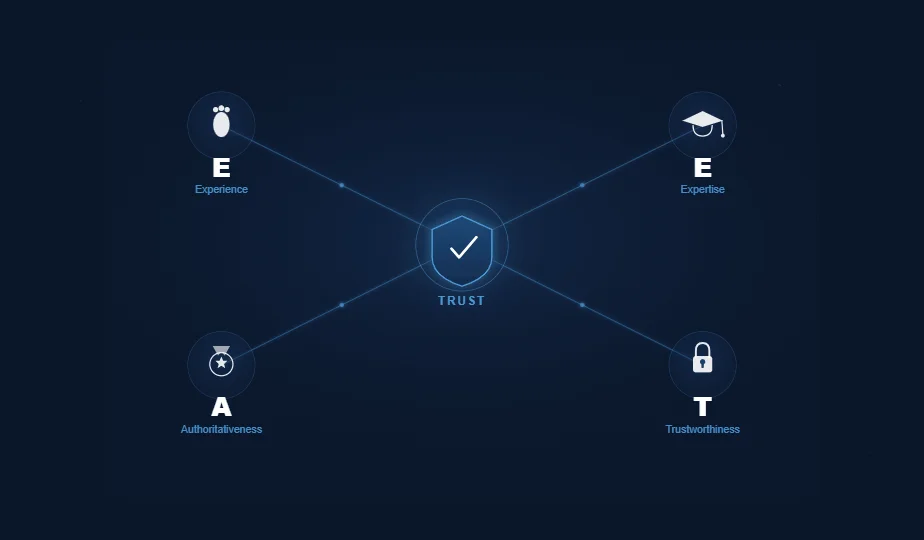
E-E-A-T in SEO is the framework Google uses to evaluate whether your content deserves to rank, and in 2026, whether it deserves to be cited by AI. It stands for Experience, Expertise, Authoritativeness, and Trustworthiness, and if you’ve read anything else on the AutiMark blog, from our dental SEO guide to our eCommerce SEO strategy to our AI Overviews and zero-click search post, you’ve seen us reference it as critical without ever fully explaining it.
This is the explanation. Every other post now points here.
And the timing isn’t accidental. Google’s March 2026 Core Update reshuffled 79.5% of top-3 positions, the most volatile core update ever measured (SE Ranking, 2026). Sites with weak E-E-A-T signals were hit hardest. Meanwhile, AI Overviews now appear on roughly one in five queries, and independent analysis of 2,400 AI Overview citations found that pages ranking 6th through 10th with strong E-E-A-T signals were cited 2.3 times more often than first-ranked pages with weak authority signals. Rank alone doesn’t win anymore. Trust does.
Key Takeaways
- E-E-A-T stands for Experience, Expertise, Authoritativeness, and Trustworthiness. It is not a direct ranking factor, it’s Google’s quality evaluation framework, embedded in the 182-page Search Quality Rater Guidelines, used by approximately 16,000 human raters worldwide to calibrate the signals Google’s algorithms learn from.
- Trust is the most important of the four. Google’s own guidelines (Section 3.4) state explicitly: “Trust is the most important member of the E-E-A-T family because untrustworthy pages have low E-E-A-T no matter how Experienced, Expert, or Authoritative they may seem.”
- The March 2026 Core Update was the most volatile in Google’s history, and sites with original data gained +22% visibility while AI-paraphrased content lost 71% of its traffic (SE Ranking, 2026).
- E-E-A-T is not just a Google ranking concept anymore. 96% of AI Overview citations come from sources with verified E-E-A-T signals (Wellows, 2026), and AI systems like ChatGPT and Perplexity perform entity verification through sameAs chains, author profiles, and external corroboration before deciding to cite.
- A technically perfect page with no credible author, no outside validation, and no transparent sourcing can lose to a simpler article written by someone Google already trusts. That’s the shift.
What Is E-E-A-T in SEO and Why Does It Matter?
Before 2022, Google’s quality framework had three letters: E-A-T, standing for Expertise, Authoritativeness, and Trustworthiness. It was introduced in the Search Quality Rater Guidelines in 2014, mostly ignored by the SEO industry until Google’s August 2018 “Medic Update” obliterated health and finance sites that lacked credible authorship and transparent sourcing. Some lost 40 to 80% of their visibility overnight.
In December 2022, Google officially added the second “E” for Experience, acknowledging that first-hand, lived involvement with a topic matters and is distinguishable from book knowledge alone. A hotel review from someone who actually stayed there. A software tutorial from someone who built with that tool. A legal guide written by a practicing attorney, not a content writer who researched the topic for an afternoon.
The framework in plain terms:
Experience asks: did the content creator personally do, use, or live through what they’re writing about?
Expertise asks: does the creator have demonstrable knowledge, credentials, or a track record in this subject?
Authoritativeness asks: do other credible sources recognize this creator or this website as a go-to source on this topic? This is the pillar most directly tied to backlinks, brand mentions, citations, and third-party recognition.
Trustworthiness asks: is the content accurate, transparent, properly sourced, and presented on a technically secure, clearly owned website? This pillar sits at the center of the model, not equal to the others but foundational to them. Without trust, the other three collapse.

One critical distinction: E-E-A-T is not a score Google assigns to your page. It’s a framework human quality raters evaluate against, and their assessments are then used to train the algorithmic systems (BERT, MUM, RankBrain, and more recently Gemini) that actually determine rankings. The raters’ feedback doesn’t change your ranking directly, but it teaches Google’s systems what high-quality results look like, which shapes every core update that follows. The practical difference between “not a ranking factor” and “shapes every ranking factor” is, operationally, very thin.
Why E-E-A-T in SEO Now Determines AI Citations Too
This is the section most E-E-A-T guides skip entirely, because most were written before AI Overviews became a permanent, dominant feature of search.
Google’s AI Overviews ground their responses in the same high-quality results identified by Google’s core ranking systems. The same E-E-A-T signals that earn traditional rankings also determine which pages Gemini selects as citation sources when generating an AI answer. Google’s Search Liaison Danny Sullivan said it plainly in early 2026: “SEO for AI is still SEO.”
But the mechanism is more specific than that phrase suggests. AI Overviews and other generative answer surfaces favor content from entities Google has high confidence in, and confidence here is not subjective. It’s a graph traversal: Google’s systems follow sameAs chains from your Person and Organization schema to Wikidata, Wikipedia, LinkedIn, ORCID, and other registries to verify that the author claimed in your markup is the same author identified elsewhere on the open web. Sites with thin or invented author entities lose citation share to sites where those chains resolve cleanly.
This is where E-E-A-T stops being abstract and becomes mechanical:
- 96% of AI Overview citations come from sources with verified E-E-A-T signals (Wellows, 2026).
- 47% of citations come from pages ranking below position 5, meaning traditional rank isn’t the gate, trust signals are.
- Pages cited in AI Overviews earn 35% more organic clicks and 91% more paid clicks than competitors who aren’t cited on the same query (Seer Interactive, 2025).
- Pages ranking 6th through 10th with strong E-E-A-T were cited 2.3 times more often than top-ranked pages with weak authority signals (Deftsoft, 2026).

The implication is clear: if you’re optimizing for AI visibility through GEO (Generative Engine Optimization) or AEO (Answer Engine Optimization), you’re not building a separate strategy. You’re building E-E-A-T. The same signals that earn Google’s trust earn ChatGPT’s, Perplexity’s, and Gemini’s.
Our AI SEO service is built around exactly this convergence, the entity optimization, structured data, and authority signals that make your brand citable across both traditional and AI-powered search, not just one or the other.
How to Build E-E-A-T in SEO: The 4 Pillars
Theory is useful. Specific, implementable actions are more useful. Here’s the practical breakdown of how to build each pillar, mapped to real techniques rather than vague advice.
Pillar 1: Experience — Prove You’ve Done It
Experience is the pillar Google added most recently and the one most difficult to fake, which is precisely why it matters more in 2026 than ever. As AI-generated content has flooded the web, making it trivially easy to produce content that sounds expert, Google has doubled down on signals that prove first-hand involvement, because those are the signals AI generators can’t easily replicate.
How to build it:
Use “I” and “we” statements backed by specific, verifiable details. “We tested this across 15 client campaigns over six months” carries weight that “studies show this approach works” does not. Include timelines, challenges, and actual metrics from your work.
Publish original visuals, screenshots, and process documentation. These are among the clearest differentiators between content that earns citations and content that gets passed over. A screenshot of a real Search Console report showing a traffic recovery, a photo of a real implementation, a walkthrough of your actual process with your actual tools, these are experience signals quality raters and AI systems can verify.
Link content to named authors with visible bios that showcase real projects. An author bio that says “John is a content writer who covers SEO topics” scores drastically lower on the Experience pillar than one that says “John has managed technical SEO for 40+ eCommerce sites since 2019, specializing in migration recovery.” The specificity is the signal.
Our own case studies are a direct example of this: real client data, named strategies, measurable before-and-after results, not hypothetical illustrations of what could happen.
Pillar 2: Expertise — Prove You Understand It
Expertise is demonstrable knowledge. For everyday topics like recipes or travel reviews, life experience alone can qualify. For YMYL topics, healthcare, finance, legal advice, anything where wrong information can genuinely harm someone, Google holds expertise to a formal standard: credentials, education, professional qualifications, and evidence of deep subject-matter competence.
How to build it:
Create detailed author profiles with verifiable credentials. Years of experience, certifications, areas of specialization, and links to external verified profiles like LinkedIn. Attribute content to real people, not anonymous bylines, because anonymous content on a YMYL topic is now functionally disqualified from high E-E-A-T ratings.
Implement Person schema with sameAs links for every named author on your site. This is the technical mechanism that connects your author’s byline to their external identity, and it’s the exact entity chain AI systems traverse when deciding whether to trust a source. Our schema markup guide walks through the full Person schema implementation with working JSON-LD code.
Support claims with credible primary sources, not vague references. “According to Google’s 2025 Quality Rater Guidelines, Section 3.4…” carries more trust signal than “Google has said this is important.” Cite the actual document. Link to it. Show you’ve read the primary source, not a summary of a summary.
Cover edge cases and exceptions, not just the standard advice. “This approach works well in most cases, except when X happens” is an expertise signal. It shows you’ve encountered the failure modes, not just the textbook version.
Pillar 3: Authoritativeness — Prove Others Recognize It
Authoritativeness is what other people say about what you know. It’s the most difficult pillar to build quickly because it depends on external recognition: backlinks from credible publications, brand mentions, citations in industry discussions, directory listings, and third-party reviews.
How to build it:
Earn editorial backlinks from relevant, authoritative sites in your vertical. A citation from a recognized industry publication carries more authority weight than dozens of links from unrelated blogs. Quality and relevance over volume. Our link building service focuses specifically on real editorial placements, not bulk link packages, because Google’s systems (and AI citation models) evaluate link credibility, not just link count.
Build consistent brand mentions across the web. Even unlinked brand mentions contribute to entity-level authority that Google is increasingly effective at detecting. Directory listings, press mentions, podcast appearances, conference speaking, industry award entries, all of these strengthen the external authority graph around your brand entity.
Ensure your Organization schema includes complete sameAs links pointing to every verified external profile. This is the structured data equivalent of proving authoritativeness: you’re declaring “these external profiles all describe the same entity,” and search engines and AI systems use those links to consolidate your authority signals into one recognized entity record.
Pillar 4: Trustworthiness — Prove It’s Safe to Rely On
Trust is not one of the four pillars. It’s the foundation the other three sit on. Google’s own documentation says this directly: a page with no trust scores low E-E-A-T regardless of how expert, experienced, or authoritative it appears.
How to build it:
Content-level trust: Cite primary sources. Name your authors. Date your content and keep it updated. Include a “last reviewed” date on YMYL content. Be honest about what you don’t know or where your advice has limitations. Disclose commercial relationships.
Site-level trust: HTTPS is non-negotiable. A visible, complete contact page. A clear privacy policy and terms of service. No deceptive ads, no misleading interstitials, no hidden commercial bias.
Entity-level trust: Consistent NAP (name, address, phone) data across every directory and listing. Your Google Business Profile matching your schema matching your footer matching your directory listings. Inconsistency in any of these erodes entity trust, which is why our on-page SEO service treats NAP consistency and schema accuracy as foundational rather than optional.
One honest note about what trust cannot be: a single well-written page cannot override weak trust signals across the rest of the site. E-E-A-T is evaluated at the site and entity level, not page by page in isolation. If your contact page is missing, your authors are unnamed, and your schema is thin, one excellent blog post won’t rescue the trust assessment. It has to be sitewide.
E-E-A-T for YMYL Industries: The Highest Bar
E-E-A-T in SEO matters most for YMYL industries, and every vertical AutiMark has written about falls squarely into this category. Dental practices, law firms, financial services, health and wellness, eCommerce stores selling products people put on or in their bodies, all of these are YMYL (Your Money or Your Life), meaning Google holds them to the highest possible E-E-A-T standard because wrong information in these spaces can genuinely harm people.

For YMYL content specifically, Google’s Quality Rater Guidelines are explicit: authorship and editorial oversight must be visible and verifiable. A dental blog without a named dentist author, a legal guide without a practicing attorney’s byline, a health article without a qualified reviewer, these are not just “nice to have” gaps in YMYL. They are disqualifying trust failures.
If your business operates in any YMYL vertical and your content lacks visible, credentialed authorship, that is very likely the single highest-impact thing you can fix right now, ahead of any keyword strategy, any link building campaign, any technical SEO pass. Authorship comes first because everything else builds on it.
Our guides on local SEO for small businesses and on-page SEO techniques both cover the tactical layers that sit on top of E-E-A-T, but this post is the foundation both of those assume is already in place.
E-E-A-T Myths: What It Isn’t
Being honest about what E-E-A-T isn’t matters as much as explaining what it is. Misconceptions waste time and budget.
Myth: E-E-A-T is a direct ranking factor with a score. Reality: It is a quality evaluation framework. Google’s systems learn patterns from human rater assessments, but there is no “E-E-A-T score” assigned to your pages. You cannot see it in Search Console or any third-party tool.
Myth: Schema markup alone builds E-E-A-T. Reality: Schema declares claims about your content and your entity. If those claims aren’t backed by visible, verifiable content on your pages and corroborated by external sources, the schema is just an empty assertion. Schema is the communication layer for E-E-A-T signals, not a substitute for having the actual signals.
Myth: AI-generated content automatically fails E-E-A-T. Reality: Google evaluates content quality regardless of how it was produced. AI-assisted content that demonstrates genuine editorial oversight, accuracy, real expertise, and added value can score well. What fails is low-effort, generic AI output published without human review, the kind of content the September 2025 QRG update specifically addresses by directing raters to assess whether content appears auto-generated with no added value.
Myth: You can build E-E-A-T quickly with a few tactical fixes. Reality: Experience and Expertise can be surfaced quickly by properly attributing existing knowledge (adding author bios, publishing Person schema, linking to credentials). Authoritativeness takes months of consistent output, earned mentions, and external recognition. Trust is sitewide and requires infrastructure, not just content. There’s no shortcut, but there is a prioritized order, and the highest-leverage moves come first.
Myth: E-E-A-T only matters for Google. Reality: AI platforms use the same credibility signals. ChatGPT performs entity verification before citing. Perplexity weights source authority. Google AI Overviews use E-E-A-T as a filtering mechanism during source selection. Building E-E-A-T for Google simultaneously builds your citation eligibility across every AI platform.
The 90-Day E-E-A-T Buildout: Where to Start
If you’re starting from scratch or know your E-E-A-T signals are weak, here’s the prioritized order we use with our own clients.
Days 1–14: Foundation Implement Organization schema on your homepage with complete sameAs links to every verified external profile. Add Person schema for every named author. Ensure your contact page, privacy policy, and terms of service are complete and visible. Verify your Google Business Profile matches your schema and your footer.
Days 15–30: Author Attribution Add detailed author bios to every published piece of content. Include years of experience, specific areas of expertise, and links to verified external profiles. Attribute every blog post and guide to a named, credentialed author. For YMYL content, ensure the author’s qualifications are specific to the topic.
Days 31–60: Content Trust Signals Audit your top 20 pages for source quality. Replace vague claims with cited primary sources. Add “last reviewed” or “last updated” dates to evergreen content. Update any outdated statistics, recommendations, or broken links. Add original visuals, process documentation, or screenshots that demonstrate first-hand experience.
Days 61–90: External Authority Begin earning editorial backlinks from relevant industry publications. Build directory listings and verify NAP consistency across every platform. Publish content that others in your industry will want to reference, original data, primary research, unique frameworks. Monitor AI citation frequency for your target queries using Semrush’s AI toolkit or manual checks across ChatGPT, Perplexity, and Google AI Mode.

If coordinating all four phases simultaneously alongside ongoing SEO, content, and technical work sounds like more than your team can handle in parallel, that’s exactly what our Smart SEO managed plans are structured around: E-E-A-T foundation, content, technical health, and authority building running on one coordinated monthly roadmap rather than being managed as separate, disconnected workstreams.
Frequently Asked Questions
What does E-E-A-T in SEO stand for? E-E-A-T stands for Experience, Expertise, Authoritativeness, and Trustworthiness. It is Google’s framework for evaluating content quality, embedded in the Search Quality Rater Guidelines. It is not a direct ranking factor but shapes the algorithmic signals that determine rankings and AI citation eligibility.
Is E-E-A-T a direct Google ranking factor? No. It is a quality evaluation framework used by approximately 16,000 human quality raters to assess search results. Their assessments train Google’s algorithmic systems, which means E-E-A-T indirectly shapes every core ranking update. The practical distinction between “not a ranking factor” and “trains every ranking factor” is operationally very narrow.
How does E-E-A-T in SEO affect AI search visibility? AI Overviews, ChatGPT, and Perplexity all use trust and authority signals overlapping with E-E-A-T to decide which sources to cite. Research shows 96% of AI Overview citations come from sources with verified E-E-A-T signals. Building E-E-A-T for Google simultaneously builds your citation eligibility across every AI platform.
Does AI-generated content automatically fail E-E-A-T? No. Google evaluates content quality regardless of how it was produced. AI-assisted content that demonstrates genuine editorial oversight, real expertise, and accuracy can rank and be cited well. What fails is low-effort, generic AI output published without human review.
How long does it take to build E-E-A-T? Author attribution and schema can be implemented in the first two weeks. Content trust signals take 30 to 60 days to audit and improve. External authority (backlinks, brand mentions, third-party recognition) is the slowest-moving pillar, typically requiring 3 to 6 months of consistent effort.
What is YMYL and why does it raise the E-E-A-T bar? YMYL stands for “Your Money or Your Life” and refers to topics where inaccurate information could harm a person’s health, finances, safety, or well-being. Google holds YMYL content to the highest E-E-A-T standard, requiring visible, verifiable authorship, credentialed expertise, and rigorous editorial oversight.
The Bottom Line
E-E-A-T in SEO is not a checklist you complete once. It’s the ongoing, compounding process of demonstrating to both Google and AI platforms that your content comes from real people, with real expertise, recognized by real external sources, and presented transparently on a trustworthy site. Every other SEO tactic you invest in, keywords, schema, backlinks, technical fixes, content production, performs better or worse depending on the E-E-A-T foundation underneath it.
If you are unsure where your site stands on E-E-A-T and want a clear diagnosis of what’s strong, what’s missing, and what to prioritize first, book a free strategy call and we’ll walk through your site’s specific trust signals together. You can also review our pricing and packages to see what a managed E-E-A-T buildout looks like at each budget level, or check our general FAQ for more on how engagements work.