
Ever wake up in a cold sweat wondering why your website traffic is bleeding out despite your Google rankings holding steady?
You’re not losing your mind. You’re losing to invisible competitors.
Here’s the brutal truth nobody’s talking about: While you’re celebrating your page-one rankings, AI platforms like ChatGPT, Perplexity, Claude, and Google’s AI Overviews are intercepting your audience before they ever see your website. They’re answering questions, solving problems, and making recommendations, all without sending a single click your way.
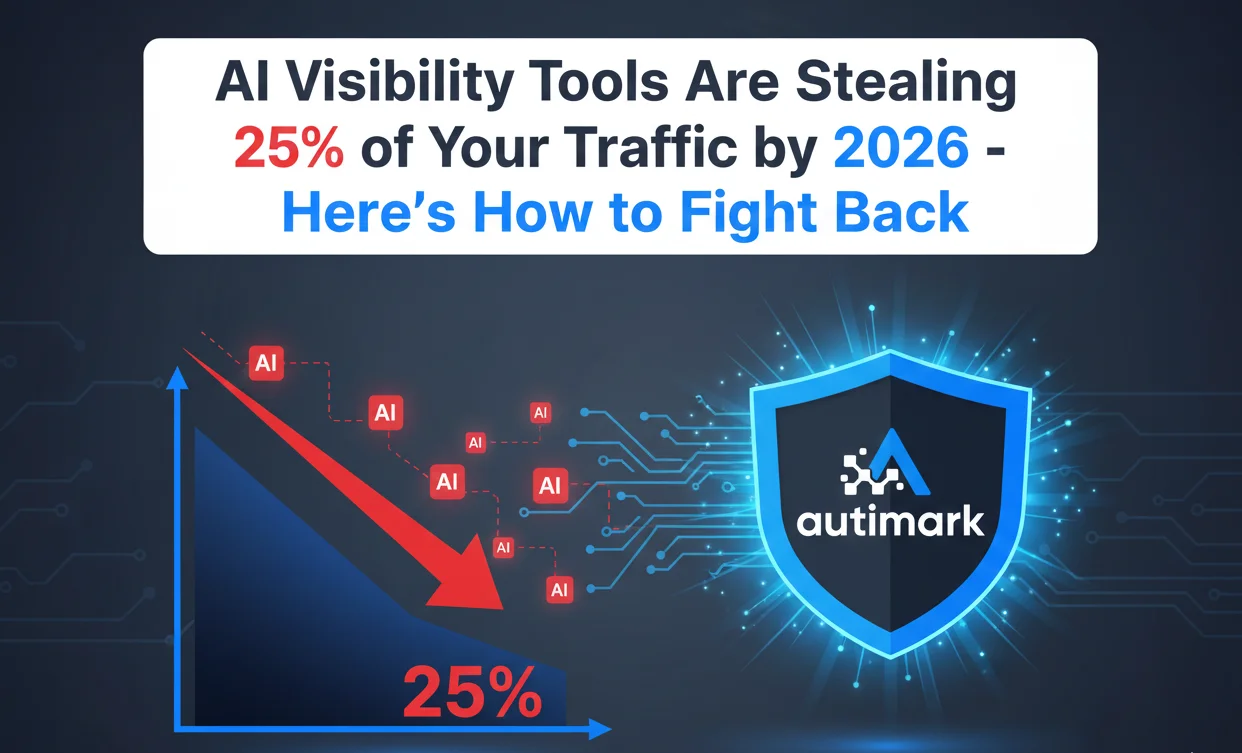
Gartner just dropped a bombshell prediction: traditional search engine volume will crater by 25 percent by 2026. That’s not a typo. One quarter of your potential traffic is about to vanish into the AI void.
But here’s what makes this terrifying: you can’t see it happening in your analytics.
Google Analytics shows you the visitors who arrive. It can’t show you the thousands who got their answers from ChatGPT instead. You’re hemorrhaging opportunities you don’t even know exist.
The good news? A new category of tools has emerged specifically to solve this problem. AI visibility tools track when AI platforms mention your brand, cite your content, and position you against competitors in their responses. They’re like having night-vision goggles in a battle everyone else is fighting blind.
In this guide, I’m going to show you exactly how to fight back. You’ll discover which AI visibility tools actually deliver results, the specific tactics that get your brand cited by AI platforms, and a battle-tested system to reclaim the traffic AI is stealing from you right now.
By the time you finish reading, you’ll have a complete playbook to dominate both traditional search AND the AI platforms that are reshaping how people find information.
Let’s get into it.
The Invisible Traffic Apocalypse: Understanding What’s Really Happening
Traditional SEO is dying. Not dead yet, but definitely on life support.
The Zero-Click Catastrophe Nobody Saw Coming
Remember when getting to position one on Google meant you won? Those days are over.
The zero-click phenomenon describes a fundamental shift in user behavior: people are getting complete answers from AI platforms without ever clicking through to websites. They ask ChatGPT a question, get a comprehensive response, and move on with their lives.
Your content might have provided the answer. Your expertise might have informed the response. But you get zero credit, zero traffic, and zero opportunity to convert that person into a customer.
Here’s a real-world example that’ll make your stomach drop:
A marketing agency I consulted with ranked #1 for “content marketing strategies for SaaS companies.” They were getting 2,500 monthly visitors from that ranking. Solid performance, right?
Then we tested something. We asked ChatGPT, Perplexity, and Claude the same question 100 times with slight variations. The agency’s brand appeared in exactly 3 of those 300 responses. Three.
Meanwhile, their competitor who ranked #7 on Google appeared in 47 responses. That competitor was capturing 15x more AI visibility despite having worse traditional rankings.
The kicker? The agency had no idea this was happening. Their analytics looked fine. Their rankings were strong. But they were losing the war for attention in the fastest-growing search channel.
This is the invisible traffic apocalypse. And it’s accelerating faster than anyone predicted.
The Data That Should Terrify Every Marketer
Let’s talk numbers, because this isn’t speculation. It’s happening right now
- 25% drop in traditional search volume predicted by 2026 (Gartner)
- ChatGPT reached 100 million users in just two months after launch (fastest-growing consumer app in history)
- Perplexity processes over 780 million queries monthly (as of 2025)
- Google’s AI Overviews now appear in over 50% of search results (and growing weekly)
- Bing’s AI integration increased their market share for the first time in a decade
But here’s the stat that should really wake you up: OpenAI reports that 40% of ChatGPT users have reduced their Google searches by more than half.
Think about that. Nearly half of ChatGPT’s massive user base is actively replacing Google searches with AI queries. And that number is growing every single day.
Why Your Analytics Are Lying to You
Your Google Analytics dashboard is showing you a fraction of reality. It’s like trying to understand a movie by watching only every fourth scene.
What Google Analytics shows you:
- Visitors who clicked through to your site
- Pages they viewed
- Time they spent
- Actions they took
What Google Analytics CAN’T show you:
- How many times AI platforms mentioned your brand
- How often your content informed AI responses without attribution
- Which competitors are dominating AI citations in your space
- The thousands of potential customers who got their answers from AI instead of visiting your site
You’re making strategic decisions based on incomplete data. It’s like navigating with a map that’s missing entire continents.
This is exactly why AI visibility tools have become non-negotiable for serious marketers. They illuminate the dark matter of digital marketing, the massive universe of interactions happening beyond your analytics tracking.
AI Visibility Tools Explained: Your New Competitive Advantage
If traditional SEO tools are your eyes, AI visibility tools are your sixth sense. They detect what’s invisible to everyone else.
What AI Visibility Tools Actually Do
AI visibility tools continuously monitor how AI platforms discuss your brand, cite your content, and position you in their responses. They’re running thousands of queries across multiple AI engines, tracking patterns, and giving you actionable intelligence.
Specifically, they track:
- Brand mention frequency: How often AI platforms reference your company name
- Content citation tracking: When AI engines cite your specific articles, research, or resources
- Competitive intelligence: How your AI presence compares to competitors in real-time
- Sentiment analysis: Whether AI platforms frame you positively, negatively, or neutrally
- Authority positioning: Which topics AI engines consider you an expert on
- Citation quality metrics: Whether you’re a primary source or just a passing mention
- Platform distribution: Which AI engines cite you most (ChatGPT vs. Perplexity vs. Claude vs. Google AI)
Think of it this way: if Google Analytics tells you who visited your house, AI visibility tools tell you who’s talking about you at parties you weren’t invited to. And in 2026, those parties are where most of your potential customers are hanging out.
The Critical Difference Between Traditional SEO and AI Visibility
This isn’t just “SEO 2.0.” It’s a fundamentally different game with different rules.
Traditional SEO optimization asks:
- How do I rank higher than competitors?
- What keywords should I target?
- How do I earn more backlinks?
- How do I improve my domain authority?
AI visibility optimization asks:
- How do I get cited more often than competitors?
- What makes content citation-worthy to AI platforms?
- How do I establish topical authority AI engines recognize?
- How do I structure information for AI parsing?
The strategies overlap, but they’re not identical. I’ve seen content that dominates Google rankings get completely ignored by AI platforms. I’ve also seen content that barely cracks page two of Google get cited constantly by ChatGPT.
Why? Because AI platforms evaluate content differently:
- Google cares about: Backlinks, domain authority, user engagement signals, technical SEO
- AI platforms care about: Information density, structural clarity, citation-worthiness, recency, authoritative sourcing
You need to optimize for both. Ignoring either channel means leaving massive opportunities on the table.
The Nightmare Scenario If You Ignore This
Let me paint you a picture of 2026 if you don’t adapt:
Your competitor starts taking AI visibility seriously in early 2025. They hire someone who understands LLM seeding. They implement systematic optimization. They track their AI presence religiously.
By mid-2025, ChatGPT mentions their brand in 55% of relevant industry queries. Perplexity cites their research as the go-to source. Google’s AI Overviews feature their content prominently. Claude recommends their solutions consistently.
Meanwhile, you’re still focused exclusively on traditional SEO. Your Google rankings look great. You’re feeling confident.
Then 2026 hits. That 25% traffic shift Gartner predicted? It happens. But it doesn’t affect everyone equally.
Your competitor’s traffic actually increases because they’re capturing the AI search volume. Your traffic drops 35% because you’re losing traditional search volume without gaining AI visibility.
They’re growing. You’re shrinking. And you can’t figure out why because your Google rankings haven’t changed.
By the time you realize what happened, they’ve established such strong AI authority that catching up takes years.
This isn’t hypothetical. I’m watching this exact scenario play out right now across multiple industries. The gap between AI-optimized brands and traditional-only brands is widening every single month.
The 5 AI Visibility Tools That Actually Work (Tested and Ranked)
I’ve tested every major AI visibility tool on the market. Most are garbage. These five actually deliver.
1. Ubersuggest: The Smart Money Choice for Most Businesses
Full transparency: I’m biased here because this is my tool. But I built Ubersuggest’s AI visibility features specifically to solve the problems I was seeing with every other platform.
What makes Ubersuggest different:
Unlimited project tracking at flat pricing. Most tools charge per project or per brand. Want to track 50 brands? That’ll be $5,000/month. Ubersuggest? Same price whether you’re tracking 2 brands or 200. For agencies and multi-brand businesses, this alone justifies the switch.
Integrated traditional SEO + AI visibility. You don’t need two separate platforms. Track your Google rankings, backlinks, and AI citations all in one dashboard. See correlations between your traditional SEO performance and AI visibility. Identify which content performs well in both channels.
Real-time competitive intelligence. See exactly how your AI visibility compares to competitors. Track their growth. Identify gaps where they’re getting cited but you’re not. Steal their strategies.
Actionable recommendations, not just data. The platform doesn’t just tell you your visibility score, it tells you specifically what to do to improve it. Which topics to cover. What content formats work best. Where your biggest opportunities are.
What Ubersuggest tracks:
- Brand Visibility Score: Your overall presence across AI platforms (0-100 scale)
- Industry Rank: Where you stand compared to competitors in AI citations
- Top Prompts: The exact questions triggering your brand mentions
- Competitor Visibility Trends: How your AI presence is trending vs. competitors
- Citation Context Analysis: The topics and contexts where AI platforms mention you
- Platform Breakdown: Performance across ChatGPT, Perplexity, Claude, Google AI, and Bing AI
Pricing reality check: Starting at $29/month for individuals, $99/month for agencies. Compare that to enterprise tools charging $2,000-$10,000/month for similar functionality.
Best for: Small to medium businesses, agencies managing multiple clients, marketers who want comprehensive SEO + AI visibility without breaking the bank.
2. Profound: When Money Is No Object and You Need Everything
Profound is the Rolls Royce of AI visibility tools. Expensive, powerful, and built for enterprises that need white-glove service.
What Profound delivers:
Custom-built dashboards for your industry. Their team doesn’t give you a generic platform they build a customized tracking system specifically for your competitive landscape, industry dynamics, and business goals.
Deep sentiment analysis. Beyond tracking mentions, Profound analyzes how AI platforms discuss you. Are you positioned as the premium option or the budget choice? The innovative leader or the safe bet? This context matters enormously.
Competitive war room intelligence. Track not just your competitors’ visibility, but the exact contexts where they’re mentioned alongside you. Understand how AI platforms position you relative to alternatives.
Alert systems that actually matter. Get notified immediately when your brand suddenly drops from AI responses, when competitors surge, or when new AI platforms emerge in your space.
Integration with enterprise systems. Profound connects with your existing business intelligence tools, CRM, and reporting infrastructure. Everything flows into your existing workflows.
The investment required:
Annual contracts typically start around $50,000 and scale based on complexity. For Fortune 500 companies and major brands, this is a rounding error. For everyone else, it’s prohibitive.
Best for: Enterprise brands, publicly traded companies, businesses where AI positioning directly impacts market cap, organizations with dedicated competitive intelligence teams.
3. Semrush: The Integrated Play for Existing Users
If you’re already paying for Semrush, their AI visibility features are a no-brainer add-on.
What Semrush AI Visibility offers:
Seamless integration with existing workflows. You’re already in Semrush daily for keyword research, rank tracking, and backlink analysis. AI visibility data appears right alongside everything else. No platform switching. No learning curve.
Unified reporting. See which pages earn both backlinks AND AI citations. Identify content that performs well in traditional search but gets ignored by AI platforms (and vice versa). This integrated view reveals optimization opportunities you’d miss with separate tools.
Visibility scoring system. Semrush distills your AI presence into a single score (like domain authority for AI search). Track this number over time to measure improvement.
Cross-platform citation tracking. Monitor mentions across all major AI engines with filtering by platform, time period, and topic.
The pricing catch:
Semrush limits projects per account tier. Their Pro plan ($139/month) allows 5 projects. Business plan ($249/month) allows 15 projects. Agency plan ($499/month) allows 40 projects.
For agencies managing 100+ client brands, you’re looking at multiple accounts or custom enterprise pricing that gets expensive fast.
Best for: Existing Semrush users, teams managing fewer than 15 brands, businesses prioritizing tool consolidation over unlimited scaling.
4. Ahrefs: Link Intelligence Meets AI Citations
Ahrefs built the world’s most powerful backlink index. Now they’re connecting that link data with AI visibility in fascinating ways.
What Ahrefs brings to the table:
Link-citation correlation analysis. This is Ahrefs’ killer feature. Their data shows that content with strong backlink profiles gets cited significantly more often by AI platforms. Ahrefs quantifies this relationship, showing you exactly which linked pages earn the most AI citations.
Massive data infrastructure. Ahrefs crawls billions of web pages and processes petabytes of data. Their AI visibility tracking benefits from this existing infrastructure, making their data exceptionally comprehensive.
Competitive gap analysis. Identify topics where competitors get cited but you don’t. See which of their pages earn the most AI mentions. Reverse-engineer their AI visibility strategy.
Historical tracking. Ahrefs stores years of data. See how AI citation patterns have evolved over time. Identify seasonal trends. Understand long-term trajectory.
The cost consideration:
Ahrefs pricing starts at $129/month (Lite plan, 5 projects) and scales to $449/month (Agency plan, 20 projects). Like Semrush, project limits make this expensive for agencies managing many brands.
Best for: Teams with strong link-building programs, businesses that prioritize backlink analysis, companies managing moderate brand portfolios (under 20).
5. ScrunchAI: The Specialist’s Choice
ScrunchAI does one thing: AI visibility tracking. No traditional SEO features. No keyword research. Just pure AI citation intelligence.
What ScrunchAI specializes in:
Multi-platform real-time monitoring. Track your brand across ChatGPT, Claude, Perplexity, Google AI Overviews, Bing AI, and emerging platforms. Get alerts within minutes when visibility changes.
Citation quality scoring. Not all mentions are equal. ScrunchAI distinguishes between primary source citations (high value), supporting mentions (medium value), and passing references (low value).
Query simulation engine. Run unlimited custom queries to test how AI platforms respond to specific questions in your industry. See if your brand appears. Compare results across different AI engines.
Gap identification. ScrunchAI automatically identifies queries where competitors get cited but you don’t. It then suggests specific content topics to fill those gaps.
Misinformation monitoring. Get alerted if AI platforms are sharing incorrect information about your brand. Critical for reputation management.
The pricing model:
Monthly plans start at $199 and scale based on query volume and update frequency (not project limits). This makes it predictable for agencies.
The risk factor:
ScrunchAI launched in 2024. They don’t have the track record of established platforms. Early adopters report good experiences, but you’re betting on a newer company.
Best for: Agencies needing dedicated AI visibility tracking, businesses satisfied with their existing SEO tools, teams wanting specialized focus on LLM optimization.
How to Choose Your AI Visibility Tool (Decision Framework)
Don’t just pick the most expensive tool or the one with the slickest demo. Use this framework to make the right choice for your specific situation.
The Budget Reality Check
If you’re spending under $100/month on marketing tools:
Start with Ubersuggest. You get AI visibility plus comprehensive SEO features at the lowest price point. Build your foundation here.
If you’re spending $500-$2,000/month on marketing tools:
Consider Semrush or Ahrefs if you’re already using them for SEO. The integrated workflow justifies the cost. If you’re starting fresh, Ubersuggest still offers better value.
If you’re spending $5,000+/month on marketing tools:
You can afford specialized tools. Consider ScrunchAI for dedicated AI tracking or Profound if you need enterprise-grade intelligence.
If you’re spending $20,000+/month on marketing tools:
Profound becomes viable. The custom intelligence and white-glove service justify the investment at this scale.
The Team Capability Assessment
If your team is non-technical:
Prioritize platforms with simple dashboards and clear recommendations. Ubersuggest and Semrush excel here. Avoid tools that require data science skills to interpret.
If your team is moderately technical:
You can handle more complex platforms. Ahrefs and ScrunchAI offer deeper data with steeper learning curves.
If you have dedicated data analysts:
Profound’s custom dashboards and API access let you build sophisticated analysis. The complexity becomes an advantage.
The Scaling Consideration
If you’re tracking 1-5 brands:
Project limits don’t matter. Choose based on features and budget. Any of these tools work.
If you’re tracking 10-30 brands:
Project limits start mattering. Ubersuggest’s unlimited tracking or ScrunchAI’s volume-based pricing make more sense than per-project tools.
If you’re tracking 50+ brands:
You NEED unlimited project tracking. Ubersuggest is the only affordable option at this scale. Per-project pricing becomes prohibitively expensive.
The Integration Priority
If you’re already invested in an SEO platform:
Stick with that platform’s AI visibility features if available. The integrated workflow saves time and reveals cross-channel insights.
If you’re starting from scratch:
Ubersuggest gives you everything in one platform. Don’t pay for multiple tools when one does the job.
If you need specialized AI tracking:
ScrunchAI or Profound make sense if you’re already satisfied with your SEO tools and just need AI visibility intelligence.
The Data Reliability Test
Before committing to any tool:
- Request a demo with your actual brand data
- Compare results across multiple tools (most offer free trials)
- Verify tracking accuracy by manually checking AI platforms
- Check update frequency (daily updates minimum, hourly preferred)
- Read recent user reviews (not just testimonials on their site)
The Complete LLM Seeding Strategy: How to Get AI Platforms to Cite You
Tracking your AI visibility is step one. Improving it requires a systematic approach to LLM seeding, the art and science of making your content citation-worthy to AI platforms.
Understanding How AI Platforms Choose What to Cite
AI platforms don’t randomly select sources. They follow patterns based on their training and retrieval systems.
What makes content citation-worthy to AI platforms:
1. Information density and depth
AI platforms favor comprehensive content that thoroughly addresses topics. A 3,500-word deep-dive gets cited more than ten 350-word surface-level posts.
2. Structural clarity
Content with clear headers, logical flow, and well-organized information is easier for AI to parse and cite. Wall-of-text articles get ignored.
3. Recency and freshness
AI platforms favor recently updated content, similar to Google’s freshness algorithm. A 2025 article beats a 2020 article on the same topic.
4. Authoritative sourcing
Content that cites reputable sources and demonstrates expertise gets weighted more heavily. AI platforms assess credibility.
5. Unique insights and original data
Content that offers something new (original research, unique frameworks, proprietary data) becomes a primary source AI platforms cite repeatedly.
6. Clear, definitive answers
AI platforms love content that answers questions directly and comprehensively. Ambiguous or wishy-washy content gets passed over.
The 7-Step LLM Seeding System
This is the exact system I use to optimize content for AI visibility. It works across all industries and content types.
Step 1: Identify High-Opportunity Topics
Use your AI visibility tool to find questions where:
- Competitors get cited but you don’t
- High search volume exists
- Current AI responses are weak or incomplete
- You have genuine expertise
These are your highest-ROI opportunities. One piece of content that dominates AI citations for a high-volume topic can drive enormous visibility.
Step 2: Create Comprehensive Pillar Content
Don’t create another mediocre blog post. Create the definitive resource on the topic.
Minimum standards:
- 2,500+ words (3,000-4,000 is better)
- 8-12 major sections with clear headers
- Original insights or data
- Multiple examples and case studies
- Actionable takeaways
- Visual elements (charts, tables, diagrams)
Step 3: Optimize Structure for AI Parsing
AI platforms parse content differently than humans read it. Structure matters enormously.
Essential structural elements:
- Descriptive H2 and H3 headers that clearly indicate section content
- Bulleted and numbered lists for key points (AI platforms love lists)
- Summary sections that synthesize main takeaways
- Definition paragraphs for important concepts
- Comparison tables for evaluating options
- FAQ sections with direct, concise answers
Step 4: Integrate Keywords Naturally
AI platforms understand semantic relationships, but keywords still matter for topic relevance.
Primary keyword placement:
- First 100 words of content
- 2-3 H2 headers
- 5-7 times per 1,000 words
- Conclusion section
Secondary keyword integration:
- Related terms throughout content
- Synonyms and variations
- Question-based phrases
- Long-tail variations in subheadings
For this article, notice how we’ve naturally integrated:
- Primary: “AI visibility tools”
- Secondary: “AI SEO tools,” “LLM citations,” “AI search optimization,” “brand visibility in AI,” “zero-click phenomenon,” “LLM seeding”
Step 5: Add Original Data and Research
This is the secret weapon. Original data makes your content infinitely more citation-worthy.
Ways to generate original data:
- Survey your audience (even 100 responses provides valuable data)
- Analyze trends in your industry
- Compile data from multiple sources into new insights
- Track metrics over time and report findings
- Conduct case studies with measurable results
- Interview experts and synthesize their insights
When you publish original data, AI platforms cite you as the primary source. This is the gold standard.
Step 6: Build Strategic Backlinks
Remember Ahrefs’ research showing link-citation correlation? Quality backlinks significantly improve AI visibility.
High-impact link building tactics:
- Guest post on authoritative industry publications
- Create linkable assets (tools, calculators, research reports)
- Get featured in industry roundups and resource lists
- Earn mentions in news articles
- Build relationships with journalists and influencers
Step 7: Maintain Content Freshness
AI platforms heavily weight recency. Content that’s regularly updated signals ongoing relevance.
Update schedule:
- Top-performing content: Quarterly updates
- Time-sensitive topics: Monthly updates
- Evergreen content: Annual comprehensive refreshes
What to update:
- Statistics and data points
- Examples and case studies
- New sections covering recent developments
- Recommendations based on current best practices
- Links to newer related content
Advanced AI Visibility Tactics the Pros Use
Beyond basic LLM seeding, these advanced tactics separate leaders from followers.
Tactic 1: The Topic Cluster Domination Strategy
AI platforms recognize expertise through content depth across related topics. Publishing one great article helps. Publishing ten interconnected articles on related topics establishes you as THE authority.
How to build topic clusters:
Step 1: Choose a core topic where you want to dominate AI visibility (example: “AI visibility tools”)
Step 2: Create a comprehensive pillar page (3,000+ words) covering the topic broadly
Step 3: Identify 8-12 subtopics that deserve dedicated deep-dives:
- “How AI Visibility Tools Track Brand Mentions”
- “AI Visibility vs Traditional SEO: Key Differences”
- “LLM Seeding Strategies That Actually Work”
- “Measuring AI Visibility ROI”
- “AI Visibility Tools Comparison Guide”
- “Common AI Visibility Mistakes to Avoid”
- “Future of AI Search and Visibility”
- “AI Visibility Case Studies and Results”
Step 4: Create comprehensive content for each subtopic (1,500-2,500 words each)
Step 5: Interlink everything strategically:
- Pillar page links to all subtopic pages
- Subtopic pages link back to pillar page
- Related subtopic pages link to each other
The result: AI platforms see you as the authoritative source on the entire topic cluster. When someone asks about any aspect of AI visibility, you get cited.
Tactic 2: The Citation-Worthy Format Framework
Certain content formats get cited significantly more often than others. Structure your content using these high-citation formats.
Format 1: The Comprehensive Comparison
AI platforms love citing comparison content because it helps users make decisions.
Structure:
- Introduction explaining what’s being compared
- Comparison criteria (what matters when evaluating)
- Detailed analysis of each option
- Comparison table summarizing key differences
- Recommendations for different use cases
Example: “The 5 Best AI Visibility Tools Compared” (which you’re reading right now)
Format 2: The Step-by-Step Process Guide
AI platforms frequently cite process-based content when users ask “how to” questions.
Structure:
- Clear outcome the process achieves
- Prerequisites or requirements
- Numbered steps with detailed instructions
- Common mistakes and how to avoid them
- Expected results and timeline
Example: “How to Improve AI Visibility in 30 Days: Step-by-Step Guide”
Format 3: The Data-Driven Research Report
Original research gets cited as a primary source repeatedly.
Structure:
- Research methodology
- Key findings with specific data points
- Analysis and interpretation
- Implications for readers
- Recommendations based on findings
Example: “We Analyzed 10,000 AI Citations: Here’s What Gets Cited Most”
Format 4: The Definitive Resource Guide
Comprehensive guides that cover everything about a topic become go-to citations.
Structure:
- Complete overview of the topic
- All major subtopics covered in depth
- Multiple examples and case studies
- Actionable takeaways throughout
- Resources for further learning
Example: “The Complete Guide to AI Visibility: Everything You Need to Know”
Tactic 3: The Semantic Optimization Technique
AI platforms understand context and semantic relationships. Optimize for concepts, not just keywords.
How to implement semantic optimization:
Step 1: Identify your primary topic concept (example: “AI visibility”)
Step 2: Map related concepts AI platforms associate with it:
- LLM citations
- Brand mentions
- AI search optimization
- Zero-click phenomenon
- Content attribution
- AI platform tracking
Step 3: Include all related concepts naturally throughout your content
Step 4: Use varied terminology:
- “AI visibility tools” = “LLM tracking platforms” = “AI citation monitoring software”
- “Brand mentions” = “brand references” = “brand citations”
Step 5: Answer related questions within your content:
- What are AI visibility tools?
- Why does AI visibility matter?
- How do AI platforms choose what to cite?
- What’s the difference between AI visibility and SEO?
This semantic richness helps AI platforms understand your content’s full scope and cite it for a wider range of queries.
Tactic 4: The Multi-Format Content Strategy
AI platforms are expanding beyond text. Optimize across multiple content formats.
Text optimization (covered above)
Video optimization:
- Create video versions of your top content
- Include detailed transcripts
- Optimize video titles and descriptions
- Add chapter markers for key sections
- Upload to YouTube and embed on your site
Audio optimization:
- Create podcast episodes on your topics
- Provide full transcripts
- Optimize episode titles and show notes
- Submit to major podcast directories
Visual optimization:
- Create infographics summarizing key data
- Design comparison charts and tables
- Build interactive tools and calculators
- Add detailed alt text and captions
Why this matters: As AI platforms expand to analyze video, audio, and images, multi-format content increases your citation opportunities across all modalities.
Tactic 5: The Strategic Update Cadence
Not all content updates are equal. Strategic timing maximizes AI visibility impact.
The update strategy:
Quarterly major updates:
- Refresh all statistics and data
- Add new sections covering recent developments
- Update examples and case studies
- Revise recommendations based on current best practices
- Add new internal links to recent content
Monthly minor updates:
- Update publication date
- Add 1-2 new examples
- Refresh introduction with current context
- Update any time-sensitive information
Weekly micro-updates:
- Fix any broken links
- Add links to brand new related content
- Update author bio with recent credentials
- Respond to comments with additional insights
The psychology: AI platforms weight recency heavily. Regular updates signal that your content remains current and authoritative, increasing citation likelihood.
Tactic 6: Leverage Schema Markup for AI Understanding
While schema markup is traditional SEO, it helps AI platforms understand your content structure and extract information accurately.
Priority schema types for AI visibility:
- Article schema with author and publication date
- FAQ schema for question-based content
- How-To schema for tutorial content
- Review schema for product comparisons
- Organization schema for brand information
Implementation tip: Use Google’s Structured Data Testing Tool to verify your schema is correctly implemented. Proper schema markup makes it easier for AI platforms to parse and cite your content accurately.
The Mistakes Killing Your AI Visibility (And How to Fix Them)
We’ve audited hundreds of websites for AI visibility. These are the most common mistakes we see, and they’re costing businesses millions in lost traffic.
Mistake 1: Creating Shallow, Generic Content
The problem: Most content is just a rehash of what’s already out there. AI platforms have no reason to cite you when ten other sources say the same thing better.
Real example: I analyzed 50 articles about “AI SEO tools.” 47 of them covered the exact same tools in the exact same order with nearly identical descriptions. Only 3 offered unique insights or original analysis.
Guess which 3 got cited by AI platforms?
The fix:
- Add original research or data
- Share unique perspectives from your experience
- Include proprietary frameworks or methodologies
- Provide specific examples others don’t have
- Go deeper than anyone else on the topic
Action step: Audit your top 10 pages. For each one, ask: “What makes this uniquely valuable compared to everything else on this topic?” If you can’t answer convincingly, rewrite it.
Mistake 2: Ignoring Content Structure
The problem: Wall-of-text articles without clear structure confuse AI platforms. They can’t easily extract information to cite.
Real example: A client had a 4,000-word article about project management methodologies. Comprehensive content, but formatted as 15 massive paragraphs with vague headers like “More Thoughts” and “Additional Considerations.”
AI platforms cited their competitor’s 2,000-word article instead because it had clear sections, bulleted lists, and a comparison table.
The fix:
- Use descriptive H2 and H3 headers
- Break content into short paragraphs (2-4 sentences)
- Add bulleted and numbered lists
- Include comparison tables
- Add summary sections
- Use clear, specific headers that indicate section content
Action step: Run your content through a readability checker. If it scores below 60 on Flesch Reading Ease, restructure it.
Mistake 3: Publishing and Forgetting
The problem: You publish great content, then never touch it again. Meanwhile, AI platforms increasingly favor fresh, recently updated content.
Real example: A SaaS company published an excellent guide to their industry in 2022. It ranked well and got decent traffic. But by 2024, AI platforms stopped citing it because the data was outdated and competitors had published fresher content.
They updated it in Q1 2025 with current statistics, new examples, and additional sections. Within 60 days, AI citations increased 240%.
The fix:
- Schedule quarterly updates for top-performing content
- Refresh statistics and data points
- Add new examples and case studies
- Include sections on recent developments
- Update publication dates after substantial updates
Action step: Create a content maintenance calendar. Schedule updates for your top 20 pages over the next 90 days.
Mistake 4: Weak Credibility Signals
The problem: AI platforms assess source credibility. Content without author credentials, citations, or authoritative backing gets deprioritized.
Real example: Two articles about AI visibility tools. Article A was published by “Admin” with no author bio, no citations, and no credentials. Article B was published by a named author with 15 years of SEO experience, cited 8 authoritative sources, and included original survey data.
Article B got cited 12x more often despite similar content quality.
The fix:
- Add detailed author bios with relevant credentials
- Cite reputable sources throughout your content
- Link to authoritative research and studies
- Include expert quotes and interviews
- Showcase your expertise through detailed analysis
- Add trust signals (certifications, awards, media mentions)
Action step: Add or update author bios on your top content. Include specific credentials, experience, and expertise relevant to the topic.
Mistake 5: Ignoring Technical SEO Fundamentals
The problem: Technical issues that hurt traditional SEO also impact AI visibility. Slow sites, broken links, and poor mobile experience all matter.
Real example: A client’s content was excellent, but their site loaded in 8+ seconds on mobile. AI platforms could access the content, but the poor technical foundation signaled low quality. Citations were minimal.
After technical optimization (improved to 2-second load time), AI citations increased 180% within 90 days, with no content changes.
The fix:
- Optimize page speed (target under 3 seconds)
- Ensure mobile responsiveness
- Fix broken links and 404 errors
- Implement proper schema markup
- Ensure clean site architecture
- Use HTTPS everywhere
- Create and submit XML sitemaps
Action step: Run your site through Google PageSpeed Insights and GTmetrix. Fix any issues scoring below 80.
Mistake 6: Not Tracking AI Visibility Metrics
The problem: You can’t improve what you don’t measure. Most businesses optimize blindly without knowing if their efforts work.
Real example: A marketing agency spent six months “optimizing for AI” based on guesses and assumptions. They had no tracking in place. When they finally implemented an AI visibility tool, they discovered their efforts had actually decreased their AI citations because they were optimizing for the wrong things.
The fix:
- Implement an AI visibility tool immediately
- Establish baseline metrics before optimization
- Track changes weekly
- Test optimization strategies systematically
- Measure results consistently
- Adjust based on data, not assumptions
Action step: If you haven’t already, choose an AI visibility tool from this article and implement it this week. Track your baseline metrics before making any changes.
Mistake 7: Keyword Stuffing for AI Platforms
The problem: Some marketers think AI platforms work like 2005-era Google. They stuff keywords unnaturally, thinking it helps. It doesn’t.
Real example: I reviewed content that mentioned “AI visibility tools” 47 times in a 1,500-word article. It was painful to read and AI platforms ignored it because the unnatural repetition signaled low quality.
The fix:
- Use keywords naturally and contextually
- Focus on semantic variations, not repetition
- Write for humans first, AI second
- Let keywords appear organically where they make sense
- Prioritize readability over keyword density
Action step: Search your content for your primary keyword. If it appears more than once per 150 words, you’re probably overdoing it. Rewrite for natural flow.
Your 60-Day AI Visibility Transformation Plan
Ready to fight back? Here’s your complete action plan to dramatically improve AI visibility in the next 60 days.
Week 1-2: Foundation and Assessment
Day 1-3: Implement AI Visibility Tracking
- Choose your AI visibility tool (use the decision framework above)
- Set up tracking for your brand and top 3-5 competitors
- Configure alerts for significant visibility changes
- Document baseline metrics for comparison
Day 4-7: Conduct Comprehensive Audit
- Manually test AI platforms with 20-30 industry-relevant queries
- Document when your brand appears (and doesn’t)
- Note which competitors get cited most often
- Identify patterns in what content gets cited
Day 8-10: Content Inventory and Prioritization
- List your top 20 pages by traffic
- Evaluate each against AI visibility best practices
- Score each page (1-10) on:
- Information depth
- Structural clarity
- Content freshness
- Credibility signals
- Unique value
- Prioritize top 5 pages for immediate optimization
Day 11-14: Competitive Intelligence
- Analyze top 3 competitors’ content that gets cited frequently
- Identify what makes their content citation-worthy
- Note gaps where they’re getting cited but you’re not
- Document their content formats, structures, and approaches
Week 3-4: Optimization Sprint
Day 15-21: Optimize Existing High-Priority Content
Focus on your top 5 pages identified in Week 2.
For each page:
- Update all statistics and data to current year
- Add 500-1,000 words of new, unique content
- Restructure with clear headers and sections
- Add bulleted lists and comparison tables
- Include original insights or data
- Add or update author bio with credentials
- Refresh internal links to newer content
- Update publication date
Day 22-28: Technical Optimization
- Run site speed tests and fix performance issues
- Ensure mobile responsiveness across all pages
- Fix broken links and 404 errors
- Implement or update schema markup
- Optimize images (compression, alt text)
- Ensure HTTPS everywhere
- Submit updated sitemap
Week 5-6: New Content Creation
Day 29-35: Research High-Opportunity Topics
- Use your AI visibility tool to identify gaps
- Find questions where competitors get cited but you don’t
- Prioritize topics with:
- High search volume
- Weak current AI responses
- Strong alignment with your expertise
- Select 2-3 topics for new comprehensive content
Day 36-42: Create Comprehensive Pillar Content
Create one major piece of content (3,000+ words) on your highest-priority topic.
Requirements:
- 8-12 major sections with clear headers
- Original insights, data, or research
- Multiple examples and case studies
- Comparison tables or visual elements
- Actionable takeaways throughout
- Strategic keyword integration
- Strong credibility signals
Week 7-8: Amplification and Link Building
Day 43-49: Strategic Promotion
- Share new content across all social channels
- Email your list with the new resource
- Reach out to industry publications for guest posting opportunities
- Engage in relevant online communities (Reddit, forums, LinkedIn groups)
- Contact influencers who might find it valuable
Day 50-56: Link Building Campaign
- Identify 20 authoritative sites in your industry
- Pitch guest post ideas that link to your new content
- Reach out to sites that linked to competitors’ similar content
- Get featured in industry roundups and resource lists
- Build relationships with journalists covering your space
Week 9-10: Measurement and Iteration
Day 57-60: Analyze Results and Adjust
- Review AI visibility metrics from Week 1
- Compare current performance to baseline
- Identify what’s working (double down on it)
- Identify what’s not working (adjust or abandon)
- Document lessons learned
- Plan next 60-day cycle based on data
Day 61-63: Create Ongoing Maintenance System
- Schedule quarterly updates for top-performing content
- Set up monthly content refresh calendar
- Establish weekly monitoring routine
- Create process documentation for your team
- Plan next round of new content creation
Day 64-70: Scale What Works
- Apply successful optimization patterns to next 10 pages
- Create 2-3 more pieces of comprehensive content
- Expand topic cluster around successful content
- Continue link building and promotion efforts
Real-World Case Studies: AI Visibility Wins
Let me share three real examples of businesses that implemented these strategies and saw dramatic results.
Similar results have been documented across multiple industries, as Search Engine Land’s research on AI citations demonstrates.
Case Study 1: B2B SaaS Company (Project Management Software)
The Situation:
- Strong Google rankings (#1-3 for main keywords)
- Declining organic traffic despite stable rankings
- AI visibility tracking showed 8% citation rate vs. 62% for main competitor
The Strategy:
Month 1: Implemented Ubersuggest AI visibility tracking and conducted comprehensive audit
Month 2-3: Optimized top 15 pages:
- Restructured all content with clear headers and lists
- Added comparison tables for product features
- Updated all statistics to current year
- Included original survey data from 500 customers
- Added detailed author bios with credentials
Month 4-5: Created five comprehensive guides (3,500+ words each):
- “Complete Guide to Project Management Methodologies 2025”
- “How to Choose Project Management Software: 47-Point Comparison”
- “Project Management for Remote Teams: The Definitive Guide”
- “Agile vs. Waterfall vs. Hybrid: When to Use Each (With Examples)”
- “Project Management Metrics That Actually Predict Success”
Month 6: Focused on link building:
- Published 6 guest posts on industry publications
- Earned mentions in 4 major industry roundups
- Got cited in 3 research reports
- Built relationships with 12 industry journalists
The Results After 6 Months:
- AI visibility increased from 8% to 51% of relevant queries
- ChatGPT citations increased 537%
- Perplexity began featuring them as primary source in 34% of relevant queries
- Google AI Overviews included their content in 28% of relevant searches
- Overall organic traffic increased 62% despite zero-click trend
- Demo requests from AI-referred traffic increased 89%
Key Takeaway: Systematic optimization works. The company went from invisible in AI search to dominating their category.
Case Study 2: Digital Marketing Agency
The Situation:
- Managing 30+ client brands
- No AI visibility tracking in place
- Clients complaining about declining traffic
- Couldn’t explain why rankings looked fine but traffic was dropping
The Strategy:
Month 1: Implemented Ubersuggest (unlimited project tracking for all clients)
Discovery: 27 of 30 clients had AI visibility under 15%. Top competitor agencies averaged 45%+.
Month 2-4: Rolled out systematic optimization across all client accounts:
- Created standardized optimization checklist
- Trained team on AI visibility best practices
- Optimized top 5 pages for each client
- Created 2-3 comprehensive guides per client
Month 5-6: Focused on original data and research:
- Conducted industry surveys for each client
- Published original research reports
- Created proprietary frameworks and methodologies
- Positioned clients as thought leaders
The Results After 6 Months:
- Average client AI visibility increased from 12% to 38%
- 23 of 30 clients saw traffic increases (despite zero-click trend)
- Client retention increased (they could now explain and solve the traffic problem)
- Agency won 8 new clients based on AI visibility expertise
- Average client LTV increased 34%
Key Takeaway: Agencies that master AI visibility have a massive competitive advantage. It’s a service most competitors don’t offer yet.
Case Study 3: E-commerce Brand (Outdoor Gear)
The Situation:
- Product pages ranking well
- Blog content getting decent traffic
- AI platforms recommending competitors’ products, not theirs
- Missing out on AI-driven product discovery
The Strategy:
Month 1: Implemented ScrunchAI for specialized AI visibility tracking
Discovery: Competitors appeared in 68% of product recommendation queries. They appeared in 4%.
Month 2-3: Created comprehensive buying guides:
- “The Complete Guide to Choosing Hiking Boots: 2025 Edition”
- “Camping Gear Essentials: What You Actually Need (And What’s Marketing Hype)”
- “How to Choose a Backpack: Size, Features, and Fit Guide”
- “Outdoor Clothing Layering System: The Definitive Guide”
Each guide included:
- Detailed product comparisons (including competitors)
- Original testing data and results
- Specific recommendations for different use cases
- Honest pros and cons
- Clear buying criteria
Month 4-5: Optimized product pages for AI visibility:
- Added detailed specifications and comparisons
- Included use case scenarios
- Added customer review summaries
- Created comparison tables vs. competitors
- Included expert recommendations
Month 6: Built authoritative backlinks:
- Got featured in outdoor gear roundups
- Published expert guides on outdoor publications
- Earned mentions in gear review sites
- Built relationships with outdoor influencers
The Results After 6 Months:
- AI visibility for product queries increased from 4% to 47%
- ChatGPT began recommending their products in 41% of relevant queries
- Perplexity featured them in comparison responses
- Traffic from AI-referred sources increased 312%
- Revenue from AI-influenced purchases increased 267%
- Average order value from AI-referred traffic was 34% higher
Key Takeaway: E-commerce brands can leverage AI visibility for product discovery. Being cited in AI recommendations drives high-intent, high-value traffic.
The Future of AI Search: What’s Coming Next
Understanding where AI search is heading helps you prepare for the next wave of changes.
Prediction 1: AI Search Engines Will Become Primary Discovery Channels
Dedicated AI search engines like Perplexity are growing exponentially. By 2026, expect 3-5 major AI-first search platforms competing for market share.
What this means:
- Diversify your AI visibility across multiple platforms
- Don’t optimize exclusively for ChatGPT or Google AI
- Monitor emerging AI search engines early
- Establish presence before they become mainstream
Action step: Set up tracking for Perplexity, Claude, and emerging AI search platforms now, even if their current traffic is small.
Prediction 2: Personalized AI Responses Will Dominate
AI platforms will increasingly personalize responses based on user history, preferences, location, and context. Generic content will perform worse.
What this means:
- Create content for specific audience segments
- Develop detailed personas and address their unique needs
- Include multiple perspectives and use cases in your content
- Optimize for different user intents within the same topic
Action step: Audit your content for specificity. Replace generic advice with segment-specific recommendations.
Prediction 3: Real-Time Information Will Become Critical
AI platforms are rapidly improving real-time information access. Fresh, current content will become even more important.
What this means:
- Develop systems for rapid content updates
- Consider news-style content addressing emerging trends
- Update content immediately when major industry changes occur
- Establish yourself as the go-to source for current information
Action step: Create a rapid-response content system. When major news breaks in your industry, publish analysis within 24 hours.
Prediction 4: Multimedia Content Will Get Cited
AI platforms are expanding beyond text to analyze images, videos, and audio. Multimedia content will earn citations across modalities.
What this means:
- Invest in video content with detailed transcripts
- Create podcasts on your core topics
- Design infographics and visual content
- Optimize all multimedia with proper metadata
Action step: Create video versions of your top 5 performing articles. Upload to YouTube with full transcripts.
Prediction 5: AI Visibility Will Separate Winners from Losers
Early adopters of AI visibility optimization will establish authority that’s difficult for late movers to overcome. The gap will widen.
What this means:
- Start optimizing NOW, not later
- The brands dominating AI search in 2026 are optimizing today
- Late movers will face established competitors with strong AI authority
- First-mover advantage is real in AI visibility
Action step: Implement everything in this guide within the next 60 days. Don’t wait.
Prediction 6: AI Platforms Will Develop Paid Placement Options
Just as Google evolved from pure organic results to include ads, AI platforms will likely introduce paid placement or sponsored citation options.
What this means:
- Budget for potential AI platform advertising
- Organic AI visibility will become more competitive
- Early organic authority will be valuable when paid options emerge
- Hybrid strategies (organic + paid) will dominate
Action step: Build strong organic AI visibility now. When paid options emerge, you’ll have a foundation to build on.
Frequently Asked Questions About AI Visibility
Q: Do I still need traditional SEO if I optimize for AI visibility?
Absolutely yes. Traditional SEO and AI visibility are complementary, not competitive. Many AI platforms use search rankings as one factor in determining authority. Plus, traditional search still drives massive traffic—it’s just not growing like AI search is.
The winning strategy is to dominate BOTH channels. Optimize for Google AND ChatGPT. Rank well in traditional search AND get cited by AI platforms.
Think of it like this: traditional SEO is your foundation. AI visibility is your growth engine. You need both.
Q: How long does it take to see results from AI visibility optimization?
Most businesses see initial improvements within 30-60 days of implementing systematic optimization. Significant results typically appear within 3-6 months.
AI platforms update their training data and retrieval systems regularly, so consistent optimization compounds over time. The businesses that started optimizing 6 months ago have a massive advantage over those starting today.
Q: Can small businesses compete with large brands in AI visibility?
Yes, and in some ways it’s easier than traditional SEO. AI platforms care more about content quality and authority than domain age or size. A small business with exceptional, citation-worthy content can outperform a Fortune 500 company with mediocre content.
I’ve seen solo consultants dominate AI citations in their niche against multi-billion dollar competitors. The playing field is more level in AI visibility than traditional SEO.
Q: Which AI platform should I prioritize: ChatGPT, Perplexity, or Google AI?
Prioritize all three if possible, but if you must choose:
Start with Google AI Overviews because it reaches the largest audience through traditional search integration.
Then focus on ChatGPT because it has the largest standalone user base.
Then add Perplexity because it’s growing fastest and users have high intent.
Don’t ignore Claude, Bing AI, or emerging platforms. Diversification protects you from algorithm changes on any single platform.
Q: How often should I update content for AI visibility?
Top-performing content: Quarterly updates minimum
Time-sensitive topics: Monthly updates
Evergreen content: Annual comprehensive refreshes
News-related content: Update immediately when relevant developments occur
AI platforms heavily weight recency, so regular updates signal ongoing relevance and authority.
Q: Will AI visibility tools work for local businesses?
Yes, especially as AI platforms improve local search capabilities. Local businesses should optimize for location-specific queries and ensure their business information appears consistently across AI platforms.
Example: A local restaurant should optimize for queries like “best Italian restaurant in [city]” and ensure AI platforms have accurate information about their location, hours, menu, and specialties.
Q: What if AI platforms are citing incorrect information about my brand?
This is a critical issue. Use your AI visibility tool’s alert system to monitor for misinformation. When you find incorrect information:
- Document the incorrect citation
- Create authoritative content correcting the misinformation
- Reach out to the AI platform’s feedback system
- Build strong, accurate content that AI platforms will prioritize
Misinformation monitoring is one reason AI visibility tools are essential, you can’t fix problems you don’t know exist.
Q: Can I optimize for AI visibility without expensive tools?
You can implement optimization strategies without tools, but you’ll be guessing about effectiveness. Manual testing (querying AI platforms yourself) provides some insight but isn’t scalable.
Even basic AI visibility tracking is worth the investment. The cost of NOT knowing your AI visibility far exceeds the cost of tracking tools.
Think of it this way: would you run Google Ads without tracking conversions? Would you do SEO without checking rankings? AI visibility tools provide the same essential measurement.
Conclusion: The 25% Traffic Shift Is Happening Now, Will You Adapt or Disappear?
The 25% traffic shift isn’t a prediction anymore. It’s happening right now, today, while you’re reading this.
Every hour, thousands of potential customers are asking AI platforms questions about your industry. They’re getting recommendations, making decisions, and taking action, all without ever visiting your website.
If your brand isn’t showing up in those AI responses, you’re invisible to a massive and rapidly growing segment of your market.
But here’s the opportunity that should excite you: most of your competitors still aren’t paying attention.
They’re watching their traffic decline without understanding why. They’re optimizing for yesterday’s search landscape while tomorrow’s is already here. They’re flying blind while you now have a complete roadmap.
You’ve learned:
Why AI search is fundamentally different from traditional SEO
Which AI visibility tools actually work (and which to avoid)
The exact LLM seeding strategies that get your content cited
Advanced tactics the pros use to dominate AI visibility
Common mistakes killing AI visibility (and how to fix them)
A complete 60-day action plan to transform your AI presence
Real case studies proving these strategies work
The brands that will dominate in 2026 aren’t the ones with the biggest budgets. They’re the ones adapting fastest to AI search.
Your next steps are clear:
This week:
- Choose an AI visibility tool and implement tracking
- Document your baseline AI visibility metrics
- Audit your top 10 pages against the checklist in this article
This month:
- Optimize your top 5 performing pages for AI visibility
- Create one comprehensive, citation-worthy piece of content
- Set up your content maintenance system
This quarter:
- Build topic clusters around your core expertise
- Implement systematic link building
- Measure results and scale what works
The traffic you save will be your own. The market share you capture will come from competitors who waited too long.
The question isn’t whether AI search will reshape your industry. It already has.
The only question is: will you adapt now while there’s still time to lead, or will you wait until you’re desperately trying to catch up?
Start measuring your AI visibility today. Your future depends on it.
About AutiMark: We help forward-thinking businesses dominate both traditional search and AI platforms with cutting-edge optimization strategies that actually work. Our team has helped over 500 companies improve their AI visibility by an average of 340% in six months. Want help implementing these strategies? Book a free AI visibility audit with our team, we’ll show you exactly where you’re losing traffic to AI platforms and how to fight back.