
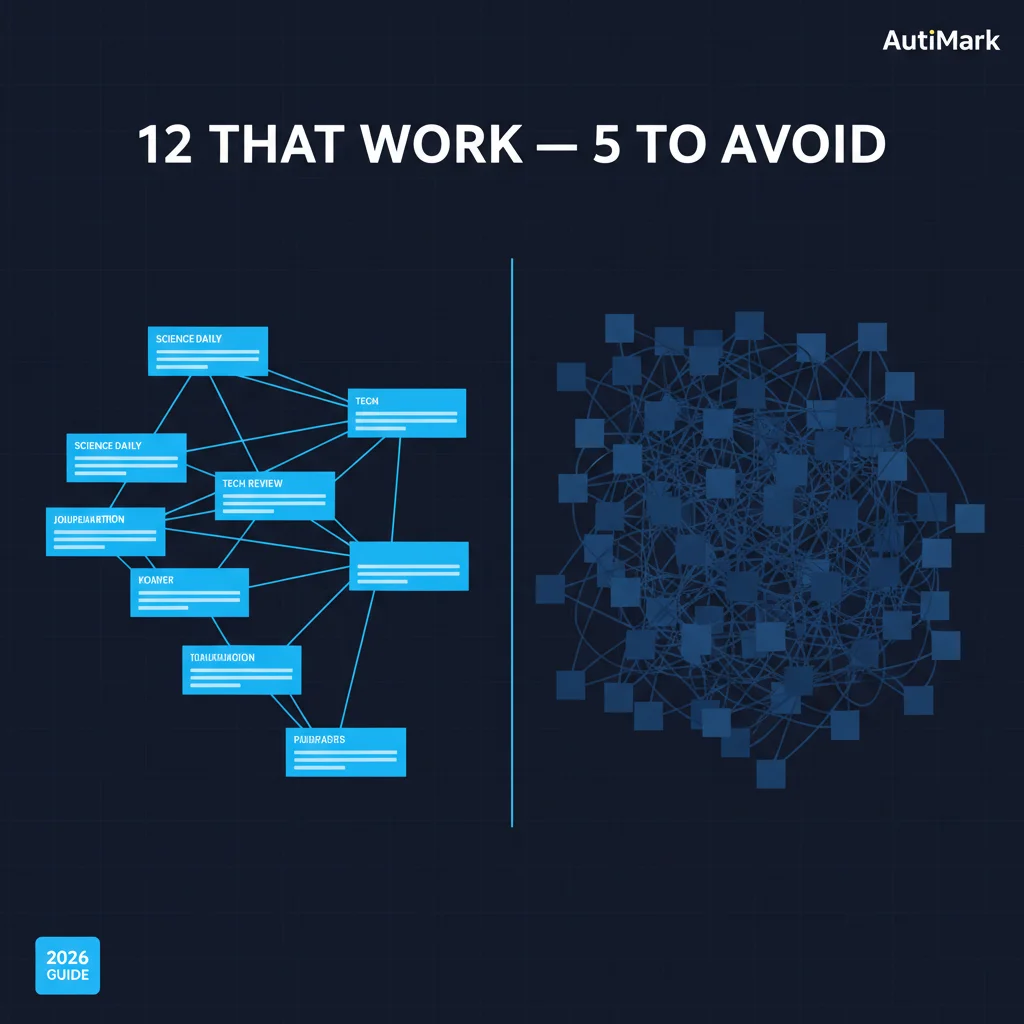
Link building strategies in 2026 have split into two camps: the ones that compound quietly for years, and the ones that get your entire domain devalued in a single algorithm update. The gap between the two is wider than it’s ever been, and it’s the reason most of the “10 easy backlink tricks” articles still ranking on page one are actively dangerous to follow.
Backlinks remain a top-3 Google ranking factor in 2026. That hasn’t changed. What has changed is what counts as a backlink worth having. Quality, relevance, and the authority of the linking domain matter far more than sheer quantity, one link from a DR 70 editorial site outperforms 100 links from DR 10 directories. Google’s algorithms now evaluate links inside a broader context that includes brand mentions, co-citations, entity relationships, and topical authority.
Here’s the number that reframes the whole conversation: over 30% of brand authority now comes from unlinked mentions that AI models use to verify trust. You don’t just need backlinks anymore. You need to be mentioned, cited, and talked about across the web in a way that both Google and ChatGPT can see.
This guide covers the 12 link building strategies our team runs across 650+ AutiMark client campaigns, the ones that survived every Google spam update since 2023, and the 5 tactics that will get you penalized in 2026. Every strategy is graded by difficulty, timeline, and cost so you can pick the ones that fit your business today.
If you’re already researching budgets before methods, our how much link building costs breakdown pairs directly with this guide.
What you’ll learn: Why Google’s 2025/2026 spam updates split the link building playbook in two, the 12 strategies that still work (grouped into content-led and relationship-led), the 5 tactics that trigger penalties, how to match strategies to your budget and stage, and how link building now feeds AI citation as well as Google rankings.
Why Link Building Strategies Changed Completely in 2026
Three shifts hit at once and rewrote the rules.
Shift 1: Google’s spam updates got aggressive. The March 2024, October 2024, and March 2025 spam updates specifically target scaled link schemes, mass-produced backlinks, and manipulative outreach. The March 2026 update tightened detection further. Ethical, strategic link building absolutely still works, but the tactical shortcuts do not.
Shift 2: AI platforms became a second surface. ChatGPT, Perplexity, Google AI Overviews, and Gemini decide which brands to cite based on brand mention density and co-citation patterns, not just PageRank. A backlink now does double duty: it passes ranking equity AND it teaches AI systems that your brand belongs in the answer.
Shift 3: Unlinked mentions became measurable authority. Google’s Knowledge Graph and every major LLM treat unlinked brand mentions as trust signals. A mention of “AutiMark” in a Forbes article, even without a hyperlink, now contributes to authority scoring in ways it never did before 2024.
The playbook that emerges from these three shifts is uncomplicated in principle: build assets people want to reference, earn placements from real publications, get mentioned everywhere it makes sense, and never touch the shortcuts. The 12 strategies below are how you execute that in practice.
Before we get into the strategies, if you’re asking whether the investment justifies itself, our is SEO worth it analysis runs the ROI math for link-led SEO across company sizes.
12 Link Building Strategies That Work in 2026
The link building strategies that compound over time fall into two categories. Content-led strategies build assets the web references passively. Relationship-led strategies earn placements through direct outreach. The strongest programs run both in parallel, content-led builds the passive base, relationship-led accelerates the results.

Each strategy below includes difficulty, timeline, and typical cost so you can choose what fits.
Category A — Content-Led Strategies (Build These Assets First)
Strategy 1: Editorial Link Building
Difficulty: High · Timeline: 6–12 weeks per campaign · Cost: $89–$599 per placement
The gold standard. Link building in 2026 is the process of earning high-quality, relevant backlinks through authority, trust, and value-driven content rather than manipulative tactics, Google prioritizes natural editorial links from credible websites. Every other strategy in this list either feeds editorial link building or substitutes for it at a lower price point.
The mechanics: identify real publications in your niche with organic traffic, pitch a genuinely useful article they’d publish anyway, get the link inside the editorial context. Not sponsored. Not paid. Editorial.
At AutiMark, we run editorial link building as a DR-tiered service, DR 30+ at $142/placement scaling up to DR 60+ at $525/placement, with native English writing, real sites with verified organic traffic, one anchor/URL per placement, and a replacement guarantee if a placement falls through. See our link building service for the full tier breakdown and inventory. For the deeper cost discussion, our how much link building costs guide compares 15+ providers.
Strategy 2: Original Data and Research
Difficulty: Medium · Timeline: 3–6 months for full compounding · Cost: Time investment or one-time research budget
Posts containing original statistics or survey data receive 70% more backlinks than standard how-to articles. This is the highest-ROI content-led strategy in existence, and almost nobody runs it because it’s harder than writing another list post.
The formula: identify a question your industry keeps arguing about with no clean data behind it. Run a survey (Typeform, Google Forms), scrape a public dataset, or audit a sample of live sites. Publish the findings with a clean methodology section, a citation-friendly headline number, and downloadable data. Every journalist, blogger, and podcast covering your niche needs statistics, and if yours is the only original source, they cite you.
Our own pricing research across 15+ link building providers is a live example: it’s already earning references from other SEO blogs simply because no one else has published the underlying numbers. Building this kind of research-backed asset is exactly what our content writing team supports when a client wants an asset built to attract links passively.
Strategy 3: Digital PR
Difficulty: High · Timeline: 4–12 weeks per campaign · Cost: $3,000–$15,000 per campaign
Digital PR is the practice of creating newsworthy content and pitching it to journalists. It turns your company into a source rather than another requester, and it’s one of the strongest ways to earn high-authority backlinks, the kind that come from tier-1 publications you’d never win through cold guest post outreach.
The three angles that actually land coverage in 2026:
- Data stories: “We analyzed X and found Y” stories that give journalists a headline.
- Contrarian expert takes: Informed opinions on trending industry news, delivered fast when the news breaks.
- Human-interest angles: The story behind the founder, the customer transformation, the unexpected pivot.
Our brand mentions and PR campaigns service runs this exact playbook, curated journalist lists, campaign angles, targeted pitching, and coverage tracking. Digital PR now doubles as AI citation fuel: a tier-1 mention that feeds ChatGPT and Perplexity’s understanding of your brand is worth more than the backlink itself.
Strategy 4: Skyscraper Technique (Updated for 2026)
Difficulty: Medium · Timeline: 8–16 weeks · Cost: Content production + outreach time
The skyscraper technique still works in principle, find the best-performing content on your topic, build something demonstrably better, then outreach to the sites linking to the original. But “better” in 2026 doesn’t mean “longer.” It means:
- Fresher data (the original is probably 2–3 years old)
- Stronger structural clarity (H2/H3 hierarchy, scannable lists, BLUF paragraphs)
- Complete coverage of subtopics the original missed
- Cleaner visuals (charts, diagrams, screenshots)
- Genuine expertise from the author
The 2026 failure mode: adding 3,000 words of fluff to a 4,000-word post and calling it “the comprehensive guide.” Google’s helpful content system catches that immediately, and no journalist links to it.
Strategy 5: Ultimate and Comprehensive Guides
Difficulty: High · Timeline: 30–60 hours to produce, months to compound · Cost: Production time
Complete guides remain one of the most effective link building strategies. Backlinko’s original guide to Google RankBrain took roughly 30 hours to write and has earned over 1,000 backlinks. Depth creates passive link equity because guides become the reference resource everyone links to when they need to explain a concept quickly.
The rule: one topic, exhaustively covered, updated annually. Don’t publish 20 mediocre guides. Publish 3 that are unmistakably the best resource on the web for their topic. The guide you’re reading now is built on this principle.
Strategy 6: Free Tools and Calculators
Difficulty: Medium–High (requires dev work) · Timeline: 4–8 weeks to build, months to compound · Cost: Development time or budget
Product-led link building. Sites don’t link to sales pages. They link to useful things. A free tool that solves a specific problem, an SEO audit, a pricing calculator, an ROI estimator, a name generator, a color palette tool, earns links naturally for years after launch.
Our free SEO audit tool is a live example: it surfaces the technical issues most sites don’t know they have, and it earns links because it’s genuinely useful to link to. The build is the up-front cost; the link equity is the compounding return.
Category B — Relationship-Led Strategies (Outreach-Driven)
Strategy 7: Guest Posting (The 2026 Version)
Difficulty: Medium · Timeline: 4–8 weeks per placement · Cost: Outreach time + content time
Classic guest posting still works, but the response rate on cold “I Would like to write a guest post about X” pitches has collapsed. The 2026 version is smarter: offer to update outdated content instead of pitching a random new topic.
The workflow:
- Find high-authority sites in your niche.
- Identify posts on those sites that are 2+ years old, ranking on page 1, but visibly out of date.
- Pitch a specific upgrade, updated stats, new sections, refreshed screenshots with your byline and one contextual link back.
You are offering a favor, not asking for one. Response rates jump from 2% to 15–20% and the placements are on pages that already rank.
Strategy 8: Broken Link Building
Difficulty: Medium · Timeline: 6–10 weeks · Cost: Time-intensive but low cash cost
Find pages on authority sites that link to dead URLs (Ahrefs and Semrush both have broken backlink checkers). Create better replacement content on your own site. Reach out to the webmaster with the specific broken link and your replacement.
Broken link building works because you’re solving a real problem for the webmaster, dead links hurt user experience and SEO. You’re not asking for a favor; you are doing them one. Success rates on personalized broken link pitches run 8–12%, several times higher than cold guest post outreach.
Strategy 9: Unlinked Brand Mention Reclamation
Difficulty: Low–Medium · Timeline: Ongoing · Cost: Minimal
The newest addition to link building strategies is co-citation and unlinked mention reclamation. Over 30% of brand authority now comes from unlinked mentions that AI models use to verify trust. Every time someone writes about your brand without linking to you, you’re leaving equity on the table, and every unlinked mention is a five-minute outreach opportunity.
The process:
- Set up Google Alerts, Mention.com, or Talkwalker for your brand name and product names.
- Weekly, review new mentions that don’t link back.
- Send a short polite email: “Thanks for the mention, would you consider linking to [relevant page]? Happy to send you an updated statistic if useful.”
Even the unlinked mentions still count for AI citation signals. Personalized outreach addressing the editor by name has a 5× higher success rate than automated templates, and unlinked-mention outreach converts higher than any other cold pitch because there’s already established context.
For the full picture of how brand mentions feed AI citations, see our guides on how to get cited by ChatGPT and how to get cited in Google AI Overviews.
Strategy 10: Expert Roundup Reversal
Difficulty: Medium · Timeline: 6–8 weeks · Cost: Time only
Instead of pitching yourself onto other people’s roundups, publish your own. Invite 10–20 experts to contribute one short quote on a specific question. Every contributor now has a reason to share the post, and many will link to it from their own sites, LinkedIn, or newsletters.
The 2026 upgrade: use platforms where experts actively pitch for PR opportunities (Featured, Qwoted, HARO successors) to source contributors, then ask contributors for a fair backlink or social share as a soft ask post-publication.
Strategy 11: Resource Page Link Building
Difficulty: Low · Timeline: Ongoing · Cost: Outreach time only
Find “Best Resources,” “Useful Links,” “Recommended Tools,” and “Reading List” pages in your industry. Google search operators do the heavy lifting: [your niche] “resources” inurl:resources, [your niche] “best tools”, etc.
Pitch your most genuinely useful guide or tool for inclusion. Success rates are moderate (5–10%) but the workflow is highly repeatable and low-risk. Resource pages are stable long-term link sources.
Strategy 12: Supplier, Partner, and Directory Links
Difficulty: Low · Timeline: Immediate · Cost: Often free or membership fees
The overlooked quick win most businesses ignore. Every business has legitimate opportunities for real, non-manipulative links:
- Supplier and manufacturer directories: If you resell products, most manufacturers list authorized dealers.
- Partner pages: Every strategic partner, integration, and reseller relationship usually gets you a listing.
- Industry associations: Chamber of commerce, trade bodies, professional certifications.
- Local business directories: Yelp, BBB, Chamber, industry-specific listings.
These are citation-style links: low individual authority, high trust value, and they build the local + entity foundation Google and AI use to verify your business is real. They’re a natural component of the on-page SEO foundation we build for local clients.
Strategy Comparison at a Glance
| # | Strategy | Difficulty | Timeline | Cost | Best For |
| 1 | Editorial Link Building | High | 6–12 wks | $89–$599/link | Every business |
| 2 | Original Data & Research | Medium | 3–6 mo | Research budget | Content-mature brands |
| 3 | Digital PR | High | 4–12 wks | $3K–$15K/campaign | Established brands |
| 4 | Skyscraper (Updated) | Medium | 8–16 wks | Content + outreach | Content teams |
| 5 | Ultimate Guides | High | Months to compound | Production time | Long-term SEO |
| 6 | Free Tools | Med–High | 4–8 wks build | Dev budget | SaaS, agencies |
| 7 | Guest Posting (2026) | Medium | 4–8 wks | Outreach time | Small teams |
| 8 | Broken Link Building | Medium | 6–10 wks | Time-intensive | Bootstrappers |
| 9 | Unlinked Mentions | Low–Med | Ongoing | Minimal | Every brand |
| 10 | Expert Roundup Reversal | Medium | 6–8 wks | Time only | Thought leaders |
| 11 | Resource Pages | Low | Ongoing | Time only | New sites |
| 12 | Supplier/Directory | Low | Immediate | Membership fees | Local + eComm |
5 Link Building Strategies That Get You Penalized
These link building strategies look tempting because they promise scale, speed, and low cost. They also violate Google’s Link Spam policies and get devalued or penalized under the 2025/2026 spam updates. Recovery from a link-based penalty takes 6–18 months. Don’t touch them.

1. Private Blog Networks (PBNs)
What it is: Buying or building a network of expired domains, publishing thin content on each, and linking them all to your money site.
Why it fails: Google identifies PBN link patterns algorithmically, shared hosting, thin content, identical footprints, unnatural link velocity. Sites caught using PBNs face manual actions that can take a year to recover from. The “undetectable PBN” doesn’t exist.
2. Scaled Automated Outreach
What it is: Software that blasts thousands of near-identical cold emails to any site with a contact form.
Why it fails: Scaled link schemes and mass-produced backlinks created through automated outreach are aggressively targeted by Google’s 2025/2026 spam updates. Even if you get placements, they’re likely on the same low-quality sites everyone else’s automated outreach also placed on, the sites Google devalues in bulk.
3. Reciprocal Link Exchanges (Direct)
What it is: “I’ll link to you if you link to me.” Explicit, mutual, and often set up in Facebook groups or Slack communities.
Why it fails: Direct reciprocal linking is called out by name in Google’s link spam guidelines as a manipulative practice. Indirect three-way exchanges (A→B, B→C, C→A) are harder to detect but still risky and still violate the guidelines.
4. Buying Links from Low-Quality Sites
What it is: Paying for links on sites whose primary business model is selling links, sites that exist to sell placements, with no real audience or editorial standards.
Why it fails: A do-follow tag is not enough if the link comes from a poor source. Simply having a link from a site that exists purely to sell links fails Google’s quality standards. Marketplace-style link vendors selling on 100+ sites for $30 each are almost always this category.
5. Keyword-Rich Exact-Match Anchors at Scale
What it is: Building most or all of your backlinks with the exact phrase you’re trying to rank for as the anchor text.
Why it fails: Natural backlink profiles have varied anchor text, brand mentions, URL anchors, generic anchors (“click here,” “learn more”), partial matches, and only a small percentage of exact match. Sites where 80%+ of anchors are exact-match keywords trigger spam filters. Diversify: aim for roughly 40% brand, 25% URL/generic, 25% partial match, and only 10% exact match.
How to Choose the Right Link Building Strategies for Your Business
Matching link building strategies to your budget, timeline, and stage is what separates programs that compound from programs that stall. Here’s the honest framework we use with new clients.

If you’re bootstrapped (under $500/month for links)
Run broken link building, unlinked mention reclamation, resource page outreach, and supplier/directory links in parallel. All four are time-intensive but low-cash. Add one ultimate guide per quarter as your content asset. Skip editorial link building until you can afford at least 3 placements per month, anything less doesn’t move rankings.
If you have $1,000–$3,000/month for links
Add editorial link building at 4–8 placements per month at DR 30–40. Continue the low-cost tactics above. Start building one piece of original data research per quarter, the compounding asset that will earn passive links for years.
If you have $3,000–$8,000/month for links
Editorial link building at DR 40–60 tier plus a digital PR campaign every quarter. This is the range where AI citation starts responding, enough brand mentions and authority signals to be recognized by ChatGPT and Perplexity. Our managed SEO plans blend link building with the on-page and content work required to compound the effect.
If you have $8,000+/month
Editorial + digital PR + free tools + original research all running in parallel. Focus is on premium placements (DR 60+) and tier-1 PR coverage. This is where category leadership starts to become defensible.
For a region-specific breakdown of what these ranges buy in local currencies, see our SEO cost in Canada breakdown.
If you are choosing an agency
Look for transparent reporting (live URLs, real metrics), no PBN inventory, DR-tiered pricing, replacement guarantees, and no “1,000 links for $99” nonsense. Our best SEO agencies in Canada roundup lists the evaluation criteria that matter.
The Realistic Timeline
Link building is a long-term investment. Most efforts take 3–6 months to show meaningful ranking improvements, and full compounding takes 12+ months of consistent execution.
Weeks 1–4: Outreach kickoff, first placements begin landing. New links need discovery and indexing (typically 2–8 weeks) before Google evaluates them.
Months 2–3: Ranking impact starts to appear on lower-competition keywords. Existing pages begin to move.
Months 4–6: Meaningful movement on primary target keywords. AI citation signals start to respond if brand mention volume is high enough.
Months 7–12: Compounding effects. Sites with 12 months of steady editorial link building typically outperform sites that bought 100 links at once, and stay ahead permanently because their link profile is defensible.
If a link building provider promises page-1 rankings in 30 days, that’s your signal to walk away. It’s mathematically impossible with legitimate methods.
Frequently Asked Questions
What are the most effective link building strategies in 2026?
The most effective link building strategies in 2026 are editorial link placement on relevant publications, original data-driven content, digital PR, broken link building, unlinked brand mention reclamation, and guest posting on authority sites with genuine audiences. Quality and relevance matter far more than quantity, one editorial link from a DR 60 site delivers more ranking power than 50 links from low-authority directories.
Does link building still work in 2026?
Yes. Google has confirmed that backlinks remain among its top three ranking factors in 2026 alongside content quality and RankBrain. What changed is the quality threshold, Google’s 2025 and 2026 spam updates devalue low-quality placements more aggressively than ever. High-quality editorial links from relevant, authoritative sites remain one of the most reliable ways to improve rankings.
How long does link building take to show results?
Most link building efforts take 3–6 months to show meaningful ranking improvements. New links need to be discovered and indexed by Google (typically 2–8 weeks), then evaluated for impact on rankings. Consistent monthly link building compounds over time, sites with 12 months of steady editorial link building typically outperform sites that bought 100 links at once.
What link building strategies should I avoid in 2026?
Avoid private blog networks (PBNs), paid link schemes from low-quality sites, automated mass outreach, direct link exchanges, and exact-match anchor text at scale. Google’s 2025/2026 spam updates aggressively target low-value link schemes and manipulative backlink tactics. The recovery time from a link-based penalty can take 6–18 months.
What is the difference between a backlink and a co-citation?
A backlink is a hyperlink from another website pointing to yours. A co-citation is when your brand is mentioned alongside other authoritative brands in the same context, without necessarily linking to you. Over 30% of brand authority now comes from unlinked mentions that AI models use to verify trust. Both backlinks and co-citations build authority, but only backlinks pass traditional PageRank.
How much does a link building campaign cost?
Link building costs $89–$599+ per editorial placement depending on domain authority tier. Monthly retainers for 8–15 quality links typically range from $2,000–$5,000/month. For a complete breakdown by DR tier, provider, and method, see our guide on how much link building costs in 2026.
Or Skip the 200 Hours of Outreach and Let Us Handle It

You’ve now seen the 12 strategies that work, the 5 that get you penalized, and the honest timeline for results. If reading this made you think “this sounds like a serious operation” — you’re right. Editorial link building alone takes 15–20 hours per placement when done properly, and the bootstrapped tactics take longer.
Our link building service runs the entire editorial workflow, prospecting, pitching, content, placement, and reporting, starting at $89/placement for DR 10+ up to $525/placement for DR 60+ with real organic traffic and full white-label reporting. See our full pricing for managed plans that combine link building with the on-page and content work required to compound results.
Book a 30-minute call and we’ll audit your current backlink profile, identify the anchor text and DR distribution gaps, and outline a realistic 90-day plan for what you’d need to build, with or without us. No pitch, just real findings.