
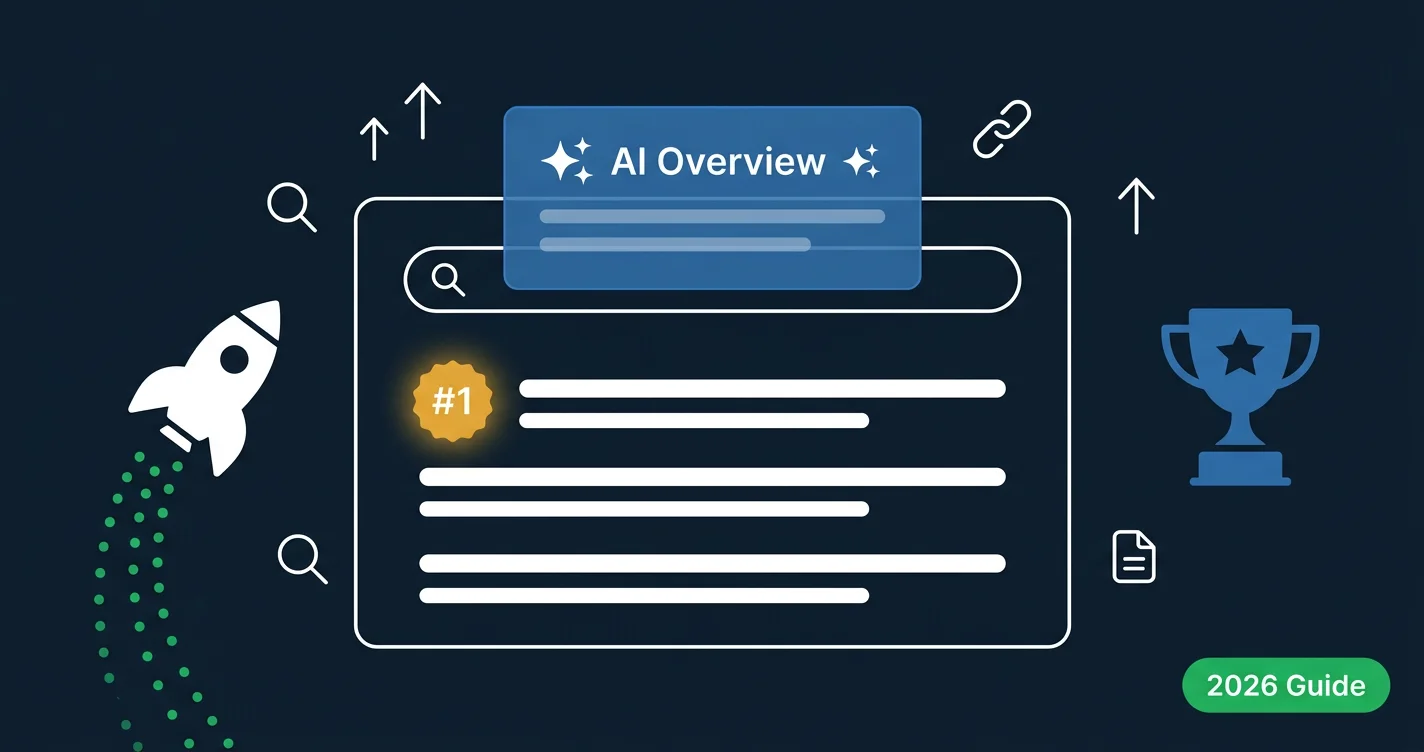
Ranking #1 on Google in 2026 is no longer the top position, the AI Overview sitting above it is.
That single fact changes everything about how SEO works now. For two decades, the goal was simple: get your page into position one of Google’s organic results and collect the lion’s share of clicks. In 2026, a site can hold position one and still lose the majority of its traffic to an AI-generated answer that appears above it, sourced from a competitor’s content.
This is not theoretical. Google AI Overviews now appear on over 60 percent of informational queries. When they show up, organic position one gets pushed below the fold on mobile. Click-through rates to traditional blue links have dropped as much as 61 percent on queries where AI Overviews appear. The search landscape has fundamentally restructured.
But here is what the panic headlines miss: organic rankings still matter enormously. They drive the majority of commercial and transactional clicks. They compound over time. And critically, the pages that get cited inside AI Overviews are almost always pages that already rank in the top 10 organic results.
This guide covers everything you need in 2026: the actual ranking factors Google uses, the content strategy that wins, the link building approach that moves positions, the technical foundations that cannot be ignored, and the new dual-ranking framework for appearing in both organic results and AI Overviews simultaneously. Whether you are a business owner trying to rank your first page or a marketer refining a strategy that already works, this is the complete reference.
Table of Contents
- Ranking #1 Is No Longer the Top Position
- How Google Decides Who Ranks: The 2026 Reality
- The 8 Google Ranking Factors That Matter in 2026
- Content Strategy: What Google Rewards Now
- Link Building: The Authority Signal That Still Decides Rankings
- Technical SEO: The Foundation You Cannot Skip
- The Dual-Ranking Framework: Organic + AI
- How Long It Takes to Rank (Honest Timelines)
- What Ranking #1 Actually Costs
- FAQ: How to Rank #1 on Google
1. Ranking #1 Is No Longer the Top Position
For twenty years, the hierarchy of Google search results was predictable: paid ads at the top, then organic results ranked one through ten. Every SEO strategy in existence was built to climb that organic ladder.
In 2026, the hierarchy looks different.

At the top of a growing number of queries sits the AI Overview, a multi-paragraph, AI-generated answer that synthesises information from multiple sources and presents it directly in the search results. Below that, you may see sponsored ads. Below that, a featured snippet or position zero. And below all of those: organic position one.
This restructuring does not make organic rankings irrelevant. It makes them necessary but insufficient. The data tells a nuanced story. For queries without AI Overviews (still roughly 40 percent of searches, and the majority of commercial and transactional queries), organic position one remains the highest-value real estate on the internet. For queries with AI Overviews, the click distribution shifts dramatically, but the sources cited within the AI Overview receive significant referral traffic and brand visibility.
The strategic implication is clear: the winning approach in 2026 is not choosing between organic rankings and AI visibility. It is building content and authority strong enough to achieve both. Every section of this guide is designed around that dual objective.
This evolution is why the SEO industry has expanded into generative engine optimization (GEO), the practice of optimising content specifically to be cited by AI systems. If you have followed the AI SEO debate, you know the landscape is shifting fast. This post connects all the pieces into a single actionable framework.
2. How Google Decides Who Ranks: The 2026 Reality
Google’s ranking system is not a single algorithm. It is a collection of systems, each evaluating different signals, that collectively determine where your page appears for a given query.
The major systems relevant in 2026 include the core ranking system (the main algorithm processing hundreds of signals including content relevance, link authority, and user engagement), the helpful content system (a site-wide classifier that rewards genuinely useful content and demotes content created primarily for search engines), the page experience system (evaluating Core Web Vitals, mobile usability, HTTPS, and intrusive interstitial absence), the link spam system (identifying and nullifying manipulative link patterns), and the reviews system (specifically evaluating product and service reviews for depth, expertise, and originality).
Understanding these systems matters because they reveal what Google actually rewards versus what SEO mythology claims. Google does not reward keyword density. It does not count how many times your focus keyword appears and assign a score. It does not use AI detection to penalize or reward content based on how it was produced. It does not rank pages based on domain age alone. And it does not guarantee rankings to anyone who follows a checklist, because every competitor is following the same checklist.
What Google rewards is straightforward: the page that best satisfies the intent behind a specific query, from a source with demonstrated authority and trustworthiness, delivered in a technically sound format. Everything in this guide serves that objective.
3. The 8 Google Ranking Factors That Matter in 2026
Google has confirmed using hundreds of ranking signals. But the signals that actually move positions, the ones that make the difference between page two and position one, cluster into eight areas.

Factor 1: Content Depth and Quality
The most important factor by a significant margin. Google evaluates whether your content comprehensively answers the query better than every competing page. “Better” means more thorough, more accurate, more actionable, and more original. A 500-word surface-level overview will never outrank a 3,000-word definitive guide that covers every angle — assuming the guide genuinely earns its length through substance rather than padding.
This is where professional content creation separates from DIY content. The gap is not word count. It is strategic depth, knowing which subtopics to cover, which questions to pre-empt, and what original insight to add that competitors have not.
Factor 2: E-E-A-T Signals
Experience, Expertise, Authoritativeness, and Trustworthiness. Google’s quality rater guidelines dedicate more pages to E-E-A-T than any other topic. In practical terms, this means your content needs a named author with verifiable credentials, your site needs clear About, Contact, and Trust pages, your claims need citations from primary sources, your content should include first-hand experience where applicable, and your site should not contain deceptive practices (misleading ads, hidden affiliate disclosures, fake testimonials).
E-E-A-T is particularly critical for YMYL (Your Money or Your Life) topics, health, finance, legal, and safety content where inaccurate information could cause real harm.
Factor 3: Backlink Authority
Links from other websites remain one of Google’s strongest trust signals. Not all links are equal. What matters is the linking site’s authority (a link from a DR70 industry publication is worth more than fifty links from obscure directories), the linking site’s relevance to your topic, the anchor text used (natural and varied is best), and the editorial nature of the link (an earned mention in an article beats a self-placed directory listing).
Link building in 2026 requires a strategic approach: digital PR, guest posting on relevant sites, broken link building, and creating content so useful that others link to it naturally. AutiMark’s link building service operates on exactly this model, manual outreach, real editorial placements, and DR-tiered pricing that lets you scale authority strategically.
Factor 4: Technical SEO
A technically broken site cannot rank, no matter how good the content is. The non-negotiable foundations include fast page load speed (under 2.5 seconds LCP), mobile-first responsive design, clean URL structure and crawlability, proper canonical tags and redirect chains, XML sitemap and robots.txt configuration, HTTPS security, and Core Web Vitals passing thresholds (LCP, INP, CLS).
Technical SEO is often the least visible but most impactful investment because it removes the ceiling on what your content and links can achieve. A free SEO audit can reveal technical issues you do not know exist.
Factor 5: Search Intent Match
Google does not rank the “best” content. It ranks the most relevant content for a specific query at a specific moment. If someone searches “best running shoes,” they expect a comparison list — not a product page and not a history of running shoes. If someone searches “buy Nike Air Max,” they expect a product page, not a blog post.
Before writing a single word, analyse the top 10 current results for your target keyword. Identify the dominant content format (list, guide, product page, video), the depth and angle of existing content, the specific questions being answered, and the user’s likely next action. Then build content that matches this intent better than anything else in the results.
Factor 6: AI Overview Eligibility
This is the new factor that did not exist two years ago. Google AI Overviews pull from pages that are already ranking in the top 10 organic results, contain clearly structured answers to specific questions, use schema markup (FAQ, HowTo, Article), have strong E-E-A-T signals, and present information in a format that AI systems can easily extract and synthesise.
Optimising for AI Overview inclusion is not a separate strategy from organic SEO, it is an extension of it. The pages that rank organically and structure their content for AI extraction get cited in both surfaces. This is the foundation of AutiMark’s dual-approach AI SEO strategy.
Factor 7: Entity Authority
Google increasingly understands the web in terms of entities, people, businesses, concepts, and the relationships between them, rather than just keywords. Your entity authority is built through consistent business information across your Google Business Profile, website, citations, and social profiles. It is strengthened through brand mentions on authoritative publications, Wikipedia references, knowledge panel presence, and structured data that explicitly defines your entity and its relationships.
Entity authority is the bridge between traditional SEO and AI visibility. The stronger your entity, the more likely Google is to rank your pages, AI Overviews are to cite you, and AI platforms like ChatGPT are to recommend you.
Factor 8: Content Freshness
For time-sensitive queries (news, trends, annual guides), freshness is a significant ranking factor. For evergreen queries, freshness matters less, but updating content with new data, sections, and improved depth sends a positive signal.
The most effective freshness strategy is not publishing new content constantly. It is maintaining a content calendar that includes quarterly updates to your highest-performing pages, adding new data and removing outdated information, expanding sections based on new People Also Ask variations, and updating publication dates only when substantial changes are made.
4. Content Strategy: What Google Rewards Now
The era of “write 2,000 words with the keyword 15 times and hit publish” is over. Google’s systems in 2026 are sophisticated enough to evaluate content along dimensions that no simple formula can game.

What ranks in 2026:
Content that adds something new to the conversation. This is the single most underestimated ranking factor. If your page restates the same ten tips that every other page on the topic offers, Google has no reason to rank it above the existing results. What earns rankings is original data (your own surveys, case studies, client results), a unique angle that reframes the topic (which is exactly what this post does with the “AI Overview is the new #1” framing), expert insight that only someone with first-hand experience can provide, and comprehensive coverage that eliminates the need to visit another page.
Content that matches the full search intent. For a query like “how to rank on Google,” the intent is broad and multi-faceted. The searcher wants to understand ranking factors, get actionable steps, know how long it takes, understand costs, and leave feeling confident they have a complete picture. Partial answers rank on page two.
Content structured for both humans and machines. Clear heading hierarchy (H1 → H2 → H3), FAQ sections that use the exact questions people ask, HowTo structures for process content, and schema markup that defines the content type, author, and topic. This structure serves readers (scannability), Google (crawl efficiency), and AI systems (extraction accuracy) simultaneously.
What does not rank:
Rehashed, generic advice without attribution or originality. Anonymous content with no author credentials. Walls of text with no structural hierarchy. Pages that answer only part of the query. Content published once and never updated. And AI-generated content that was published without human expertise, fact-checking, or original contribution, not because Google penalizes AI content, but because raw AI output is, by definition, a synthesis of what already exists. It adds nothing new.
The best content strategy for ranking in 2026 is deceptively simple: publish fewer pages, make each one the definitive resource on its topic, and invest in ongoing improvement over time. This is the approach behind every content engagement AutiMark delivers, fewer, better pages that compound in ranking power rather than a high volume of forgettable posts.
5. Link Building: The Authority Signal That Still Decides Rankings
Content gets you to page one. Links get you to position one. That oversimplification has held true for over a decade, and the data in 2026 still supports it.
Every study of ranking correlations, from Ahrefs, SEMrush, Moz, and Backlinko, finds that the number and quality of referring domains is among the strongest predictors of ranking position. Pages in position one have, on average, 3 to 4 times more referring domains than pages in positions 7 through 10.
What counts as a quality backlink in 2026:
A link from a real website that a real person visits, on a page that is topically relevant to yours, placed editorially within the content (not in a sidebar widget or footer), from a domain with legitimate authority (DR30+ as a general benchmark, DR50+ for competitive queries), with natural anchor text that is not over-optimized.
Link building strategies that work:
Digital PR, creating newsworthy data, studies, or resources that journalists and bloggers want to reference. This produces the highest-authority links but requires significant upfront investment in content creation.
Guest posting, contributing expert articles to relevant industry publications with a natural link back to your site. Effective when the publication has a real audience and editorial standards.
Broken link building, finding broken outbound links on relevant sites and offering your content as a replacement. Low response rates, but highly scalable.
Resource page link building, identifying pages that curate resources on your topic and pitching your content for inclusion.
Brand mention reclamation, finding unlinked mentions of your brand and requesting a link be added.
AutiMark’s link building service uses all of these methods with DR-tiered pricing, from DR10+ placements at $78 per link for foundational authority to DR60+ placements at $525 per link for competitive verticals. For a complete breakdown of costs, methods, and ROI expectations, see our link building pricing guide.
The critical principle: link building is not a one-time campaign. It is an ongoing programme. The site that consistently earns new links every month will eventually overtake a competitor that built a strong profile once and stopped.
6. Technical SEO: The Foundation You Cannot Skip
Technical SEO is the least glamorous part of ranking on Google and the one that derails more campaigns than any other. You can write the most authoritative content on the internet and build links from Forbes, but if Google cannot crawl, render, and index your pages efficiently, none of it matters.
The technical checklist that supports ranking:
Crawlability. Is Google able to discover and access every important page on your site? Check your XML sitemap (it should list every indexable page and nothing else), your robots.txt (it should not accidentally block important directories), your internal linking structure (orphan pages with no internal links are invisible to crawlers), and your redirect chains (every redirect should resolve in one hop, not three or four).
Indexability. Is Google choosing to index your pages? Check for accidental noindex tags, canonical tag conflicts, thin content pages that dilute your index quality, and duplicate content issues. Google has a crawl budget, it will not index everything on a large site, so you need to make sure it prioritises the right pages.
Page speed. Core Web Vitals are a confirmed ranking factor. Target LCP (Largest Contentful Paint) under 2.5 seconds, INP (Interaction to Next Paint) under 200 milliseconds, and CLS (Cumulative Layout Shift) under 0.1. Common fixes include image compression and lazy loading, eliminating render-blocking JavaScript, using a CDN, minimising third-party scripts, and server-side caching.
Mobile experience. Google uses mobile-first indexing, it evaluates the mobile version of your site for ranking purposes. Your site must be fully responsive, with no content hidden behind tabs or accordions on mobile, and with touch targets large enough for finger navigation.
Structured data. Implement schema markup on every key page: Article schema for blog posts, LocalBusiness schema for location pages, FAQ schema for question sections, HowTo schema for process content, Product schema for eCommerce pages, and Organization schema site-wide. Structured data does not directly boost rankings, but it improves how Google understands your content, increases the chance of rich result features, and is essential for AI Overview eligibility.
HTTPS. Non-negotiable. Every page must load over HTTPS with a valid SSL certificate.
For businesses that suspect technical issues are holding back their rankings, AutiMark’s free SEO audit tool reports on technical health, page speed, on-page SEO, and mobile usability. For deeper technical work, our on-page SEO service includes full technical audits, schema implementation, and site architecture optimization.
7. The Dual-Ranking Framework: Organic + AI
This is the framework that ties everything together and represents the most important strategic shift in SEO since the introduction of mobile-first indexing.
In 2026, maximum search visibility requires ranking in two layers simultaneously: the traditional organic results (positions 1-10) and the AI-generated surfaces (Google AI Overviews, ChatGPT citations, Perplexity references, voice assistant answers).
The good news: these two layers are not independent systems requiring separate strategies. They are deeply interconnected. Pages that earn organic #1 positions are the primary citation sources for AI Overviews. The signals that build organic authority, strong content, authoritative backlinks, E-E-A-T, structured data, are the same signals that AI systems use to decide which sources to cite.
The additional layer is entity and citation optimization, the work that ensures AI platforms specifically choose your content as a trusted source.

The Organic Ranking Stack (Left Branch):
Keyword research and search intent alignment → comprehensive content creation → on-page SEO optimization → strategic link building → technical SEO excellence → consistent content updates.
This stack has been the foundation of SEO for years and remains so. It is what gets you into the top 10.
The AI Citation Stack (Right Branch):
Entity authority building → structured data implementation → brand mention campaigns across authoritative publications → community mentions through forums and discussions → digital PR that establishes your brand as the definitive source → consistent content quality signals that AI models recognise.
This stack is what gets you cited inside AI Overviews and referenced by ChatGPT, Perplexity, and other AI platforms.
Where both stacks converge:
The intersection is where maximum visibility lives. A page that ranks #1 organically AND is cited in the AI Overview for the same query captures traffic from both surfaces. A brand that ranks for its target keywords AND is recommended by ChatGPT when users ask for recommendations in that space has achieved what no single-channel strategy can.
This dual-ranking framework is the core of AutiMark’s AI SEO approach. It is also the reason we structure every managed SEO engagement around both traditional and AI-era optimization signals.
8. How Long It Takes to Rank (Honest Timelines)
Anyone who promises #1 rankings in 30 days is either targeting a keyword nobody searches for or is using tactics that will get your site penalized.
Honest timelines based on data from hundreds of SEO engagements:
Low-competition, long-tail keywords (e.g., “best CRM for insurance brokers in Alberta”): 2-8 weeks for a well-optimized page on a site with moderate domain authority. These are the quickest wins and often the highest-converting queries because they carry strong commercial intent.
Medium-competition keywords (e.g., “SaaS SEO strategy”): 3-6 months with consistent content quality and link building. This is the sweet spot for most businesses, keywords with meaningful search volume that do not require enterprise-level budgets to compete.
High-competition, head-term keywords (e.g., “SEO agency”): 6-18 months of sustained effort across content, links, technical optimization, and brand building. These keywords drive the most traffic but require the most investment.
AI Overview citations: Appearing in AI Overviews typically follows organic ranking performance. If your page reaches the top 5 for a query, it becomes eligible for AI Overview citation within 1-3 months. Brand mention and entity building campaigns can accelerate this timeline by strengthening the trust signals AI systems evaluate.
The critical variable is not time, it is consistency. A business that invests steadily in content, links, and optimization for 12 months will dramatically outperform one that does an intense 3-month sprint and then stops. Rankings compound. Stopping resets the compounding.
9. What Ranking #1 Actually Costs
SEO is an investment, and understanding the cost structure prevents both overspending and underfunding.
DIY costs: If you handle SEO yourself, the direct cost is time plus tool subscriptions (Ahrefs or SEMrush at $99-$449/month, GSC and GA4 are free). The hidden cost is opportunity cost, the hours you spend learning and executing SEO are hours not spent on your core business.
Agency costs: Professional SEO services range significantly based on scope. Foundational SEO starting at $799/month covers keyword research, on-page optimization, and basic content work. Growth-stage SEO at $1,999-$3,499/month adds link building, larger content programmes, and technical optimization. Enterprise and AI-era SEO at $4,999+/month adds GEO, brand mention campaigns, and comprehensive AI visibility optimization.
For market-specific pricing, see our guides on SEO costs in Canada, SEO services in the USA, and SEO services in the UK.
Individual link costs: Link building pricing varies by authority. Expect $78 per link for DR10+ placements, $249 for DR40+, and $525 for DR60+ placements from quality sources.
ROI perspective: The reason SEO remains the highest-ROI marketing channel for most businesses is that rankings compound. A page that reaches #1 continues generating traffic for months or years without additional per-click cost. A SaaS client that invested $3,900/month in SEO for seven months generated a 702% return through organic-driven signups. An eCommerce client saw organic product page entrances triple within six months. These returns are documented in our case studies.
10. FAQ: How to Rank #1 on Google
How long does it take to rank #1 on Google? For new content on a moderately authoritative domain, reaching page one typically takes 3-6 months. Reaching position one can take 6-12 months depending on keyword difficulty and competition. Low-competition long-tail keywords can rank in weeks. High-competition head terms may take over a year of consistent investment.
Is it still possible to rank #1 on Google in 2026? Yes. Organic rankings still drive the majority of search clicks, especially for commercial and transactional queries. For queries that trigger AI Overviews, the strategy is to rank both in organic results and within AI Overview citations for maximum visibility.
What is the most important Google ranking factor? Content quality and search intent match. Google’s systems evaluate whether your page satisfies the user’s query more completely than competing results. Backlinks, technical SEO, and E-E-A-T signals support this core requirement.
Do backlinks still matter for Google rankings in 2026? Yes. Backlinks remain one of Google’s strongest authority signals. Quality matters far more than quantity. A single link from a high-authority, topically relevant site provides more ranking power than dozens of low-quality directory links.
How do I rank in Google AI Overviews? AI Overviews pull from pages already ranking in the top 10 that contain clear, structured answers. Optimise for inclusion through schema markup, entity authority building, structured content, and earning citations from trusted sources.
Can I rank on Google without backlinks? For low-competition long-tail keywords, yes. For moderately or highly competitive terms, backlinks are practically essential. The most efficient approach combines excellent content with a strategic link building programme.
How much does it cost to rank #1 on Google? Professional SEO services range from $799 to $5,000+ per month depending on scope and competition. The ROI typically justifies the investment: ranking #1 for a high-intent commercial keyword can generate significant revenue annually. For detailed cost breakdowns, see our SEO pricing guide.
Should I do SEO myself or hire an agency? If you have time to learn and execute, this guide gives you the complete framework. If your time is better spent on your core business, or if you are competing in a market where competitors are already investing heavily in SEO, working with a dedicated agency compounds results faster. The decision is usually about speed and opportunity cost, not whether SEO works.
Start Ranking Today
Every page in this guide points to the same conclusion: ranking on Google in 2026 requires disciplined execution across content, links, technical foundations, and AI visibility, not shortcuts, not tricks, and not waiting.
Start with one keyword. The one that matters most to your business. Analyse the top 10 results. Build the most helpful, authoritative page on that topic. Earn links to it. Optimise the technical delivery. Structure it for AI extraction. Then repeat.
If you want to know where your site stands right now, run a free SEO audit in 30 seconds. If you want a team to execute this framework for you, from content to links to AI search optimization, book a strategy call and let us show you the fastest path from where you are to where the traffic is.
The rules have changed. The opportunity has not. It has multiplied.