
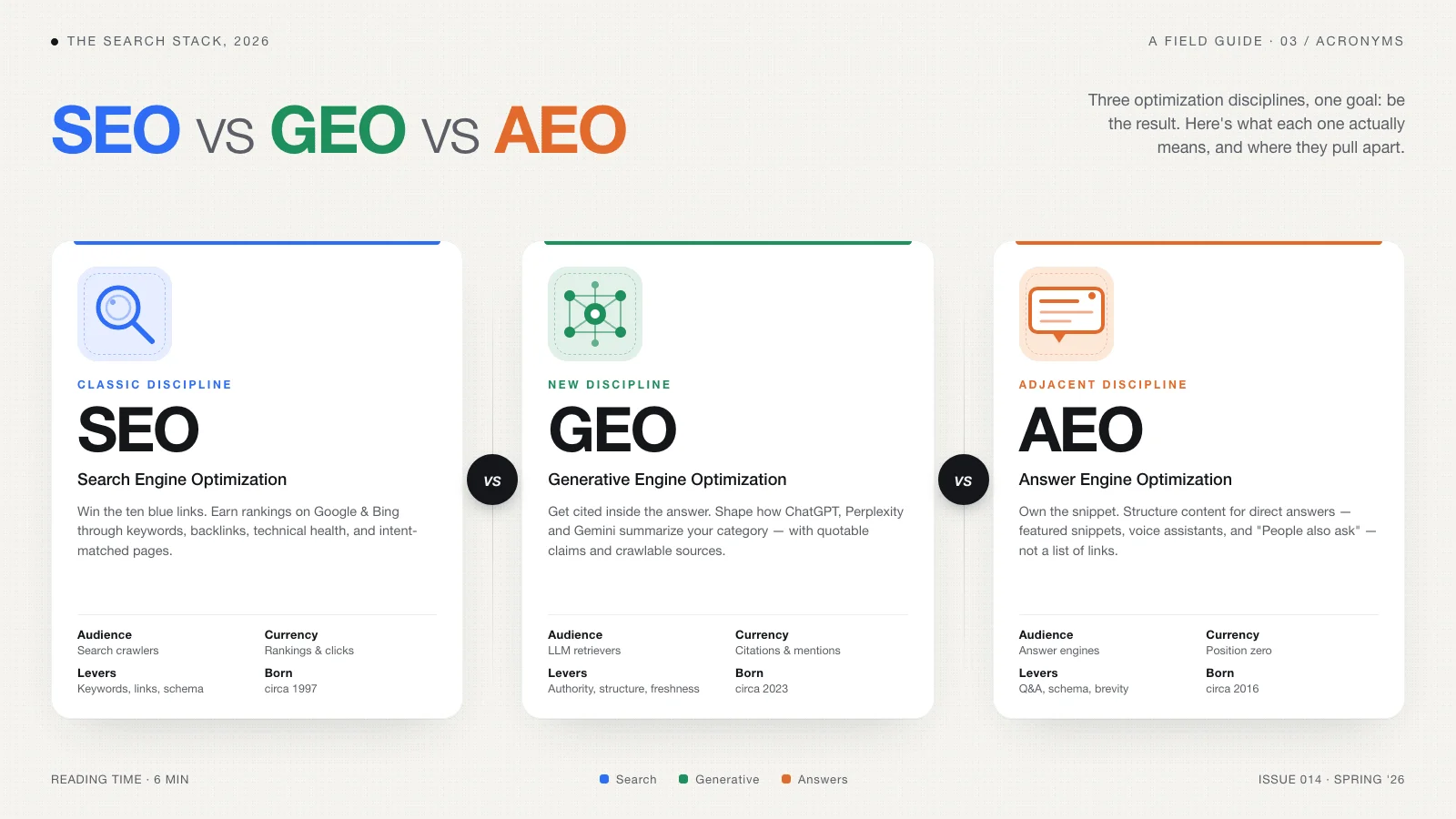
SEO vs GEO vs AEO, three acronyms that every marketer is hearing in 2026, often used interchangeably, almost always without a clear explanation of what each one actually does. Here’s the short version: SEO gets you ranked on Google. GEO gets you cited by AI platforms like ChatGPT and Perplexity. AEO gets you featured in direct-answer formats like Google AI Overviews, featured snippets, and voice search results. They overlap significantly, but they’re not the same thing, and most businesses in 2026 need all three working together to capture the full range of how people search.
This guide breaks down each discipline, explains where they overlap, where they differ, and gives you a practical framework for deciding where to invest your budget based on your business type and goals.
What Is SEO? (Search Engine Optimization)
SEO is the practice of optimizing your website to rank higher in traditional search engine results, primarily Google, but also Bing, Yahoo, and DuckDuckGo. It’s been the foundation of organic marketing for over 20 years, and despite the rise of AI search, it still drives the majority of website traffic for most businesses.
SEO covers three core areas:
Technical SEO — making sure search engines can crawl, index, and render your site properly. This includes site speed, mobile responsiveness, Core Web Vitals, clean URL structure, XML sitemaps, robots.txt configuration, schema markup, and fixing crawl errors. If your technical foundation is broken, nothing else works.
On-page SEO — optimizing the content and HTML elements on individual pages. This includes keyword research, title tags, meta descriptions, header tag hierarchy, internal linking, image alt text, and content quality. Every page needs a clear target keyword, a compelling title under 60 characters, and content that matches what the searcher actually wants.
Off-page SEO — building authority signals from outside your website. This primarily means earning editorial backlinks from other websites, but it also includes brand mentions, social signals, and digital PR. The more high-quality sites that link to you, the more Google trusts your domain.
SEO in 2026 still matters because: Google processes over 8.5 billion searches per day. Even with AI Overviews appearing on roughly half of searches, the other half still works the traditional way, ten blue links where position #1 gets the most clicks. For transactional queries (“buy”, “pricing”, “sign up”), AI Overviews only appear about 4% of the time, meaning traditional SEO still dominates purchase-intent traffic. And for local searches, the Google Map Pack still drives the majority of calls and store visits.
SEO isn’t dead. It’s the foundation that GEO and AEO build on top of.
What Is GEO? (Generative Engine Optimization)
GEO is the practice of optimizing your brand and content to be cited and recommended by AI-powered generative search platforms, primarily ChatGPT, Google Gemini, Perplexity, and Microsoft Copilot. Unlike SEO, where the goal is to rank in a list of links, the goal of GEO is to get your brand mentioned inside an AI-generated answer.
When someone asks ChatGPT “What’s the best SEO agency in Canada?” or asks Perplexity “How much does link building cost?”, the AI generates a conversational response that mentions specific brands, products, and services. GEO determines whether YOUR brand appears in those responses.
GEO focuses on signals that AI platforms evaluate differently from traditional search engines:
Entity consensus — is your brand information consistent and verified across 15+ directories, review platforms, and industry sites? AI platforms cross-reference multiple sources before mentioning a brand. The more platforms confirming the same information, the more confidently AI cites you.
Brand mentions across the web — ChatGPT doesn’t just look at your website. It evaluates how often your brand is mentioned on third-party sites, publications, forums, and social platforms. Unlinked mentions count. Every mention on a credible source is a vote of confidence.
Structured data and schema — AI-ready schema markup makes your content machine-readable. Organization schema, Service schema with pricing, FAQPage schema, and Person schema all help AI platforms understand and cite your business accurately.
Content depth and originality — AI platforms prefer comprehensive, original content over generic advice available on dozens of other sites. Pages above 20,000 characters get cited roughly 4x more frequently than pages under 500 characters.
llms.txt file — a newer standard that tells AI crawlers what your business is, what you offer, and how to interpret your site. Think of it as a robots.txt for AI platforms.
GEO matters in 2026 because: ChatGPT reached 900 million weekly active users in February 2026. Perplexity and Copilot are growing rapidly. An estimated 25% of search queries will shift to AI-powered tools by year-end 2026 according to Gartner. When someone asks an AI platform for a recommendation and your competitor gets mentioned but you don’t, that’s a lost opportunity you never even see in your analytics.
For a step-by-step guide on GEO execution, see our article on how to get your brand cited by ChatGPT in 2026.
What Is AEO? (Answer Engine Optimization)
AEO is the practice of optimizing your content to appear in direct-answer formats, Google AI Overviews, featured snippets, People Also Ask boxes, knowledge panels, and voice search results. Where SEO aims for a high ranking in a list and GEO aims for a mention inside a generated response, AEO aims for your content to BE the answer that gets displayed.
The distinction matters because answer engines work differently from both traditional search and generative AI:
Google AI Overviews pull specific passages from web pages and display them as a synthesized answer at the top of search results. Getting cited in an AI Overview delivers 35% more clicks than a standard organic position, but losing to a competitor’s citation means your #1 ranking only captures a fraction of the traffic it used to.
Featured snippets are the older, simpler version of AI Overviews, a single passage pulled from one source and displayed in a box above organic results. They still appear on many queries where AI Overviews haven’t rolled out yet.
People Also Ask (PAA) boxes expand to show additional questions and answers. Each answer is pulled from a different source, creating multiple opportunities for citation even if you don’t win the primary snippet.
Voice search results — when someone asks Siri, Alexa, or Google Assistant a question, the answer typically comes from a featured snippet or AI Overview citation. AEO directly determines whether your brand is the one read aloud.
AEO focuses on specific content formatting and structure:
Direct-answer openings — every section of your page should start with a clear, concise answer to the question posed in the heading. AI Overviews extract these opening statements. If your answer is buried in paragraph four, the AI cites someone else.
FAQ sections with schema — FAQ content structured with FAQPage schema is among the most frequently extracted content types for both AI Overviews and PAA boxes. Adding FAQ schema to every page with Q&A content dramatically increases extraction probability.
Clear H2 headers matching search queries — AI Overviews scan your headers to find sections relevant to the query. Headers that match how people actually phrase their questions (“How much does link building cost?”) perform better than vague headers (“Understanding the investment landscape”).
Concise, self-contained paragraphs — each paragraph should deliver a complete point in 2-4 sentences. Long, meandering paragraphs make it harder for AI to extract a clean, citeable passage.
AEO matters in 2026 because: AI Overviews now appear on roughly 50-58% of all Google searches. Zero-click searches, where users get their answer without visiting any website, have risen to approximately 60% of all queries. Your content either appears inside the answer box, or it sits below it where fewer and fewer users scroll. For a complete guide on AEO execution, see our article on how to get cited in Google AI Overviews.
SEO vs GEO vs AEO: Side-by-Side Comparison

Here’s how the three disciplines compare across key dimensions:
Primary goal: SEO → Rank high in traditional search results (blue links) GEO → Get cited by AI platforms (ChatGPT, Perplexity, Gemini, Copilot) AEO → Get featured in direct-answer formats (AI Overviews, snippets, voice)
Target platforms: SEO → Google, Bing (traditional organic results) GEO → ChatGPT, Perplexity, Gemini, Copilot AEO → Google AI Overviews, featured snippets, PAA, voice assistants
What gets you there: SEO → Keywords, backlinks, technical health, content quality GEO → Entity consensus, brand mentions, structured data, llms.txt AEO → Direct-answer formatting, FAQ schema, extractable content structure
How results appear: SEO → Your page listed as a clickable link in search results GEO → Your brand mentioned inside an AI-generated conversational answer AEO → Your content displayed as the answer at the top of search results
Primary metric: SEO → Rankings and organic traffic GEO → Brand citation frequency across AI platforms AEO → Featured snippet/AI Overview appearance rate and citation clicks
Time to results: SEO → 3-6 months for competitive keywords GEO → 3-6 months for initial AI citations AEO → Weeks to months (faster if pages already rank in top 10)
Cost range: SEO → $799-$7,999+/month for managed plans GEO → $1,499-$4,999/month for AI SEO services AEO → Often bundled with SEO or GEO (content restructuring + schema)
Where They Overlap (And Why That Matters)

The three disciplines share roughly 60-70% of their tactics. That overlap is good news, it means you don’t need three separate budgets or three separate agencies. Here’s what’s shared:
Quality content is required by all three. SEO needs content to rank. GEO needs content for AI to reference. AEO needs content structured for extraction. The difference is formatting and depth, not fundamentally different content.
Backlinks help all three. High domain authority improves your Google rankings (SEO), increases AI confidence in your brand (GEO), and makes your content more likely to be cited in AI Overviews (AEO). Investing in editorial link building benefits every discipline simultaneously. For cost details, see our link building pricing guide.
Schema markup benefits all three. Structured data helps Google understand your pages (SEO), helps AI platforms parse your business information (GEO), and helps AI Overviews extract your content (AEO).
FAQ content works across all three. FAQ sections target long-tail keywords (SEO), provide structured Q&A pairs for AI citation (GEO), and are among the most frequently extracted content types for AI Overviews (AEO).
Technical SEO is the shared foundation. A fast, crawlable, well-structured site benefits all three disciplines equally. If your site has crawl errors, slow load times, or broken schema, none of the three will work well.
Where They Differ (And What Each Requires Uniquely)
Despite the overlap, each discipline has tactics that are unique to it:
SEO requires specifically: Keyword optimization (title tags, H1s, content targeting specific search terms), internal linking architecture, backlink profile management, Core Web Vitals optimization, and Google Search Console monitoring.
GEO requires specifically: Entity consensus across 15+ directories, brand mention campaigns on third-party sites, llms.txt file, monitoring AI platform outputs (manually checking ChatGPT/Perplexity weekly), and creating “best of” listicle content that AI platforms cite for recommendation queries.
AEO requires specifically: Direct-answer content formatting (answer in the first sentence of every section), PAA-targeted content strategy, voice search optimization, featured snippet targeting, and Google AI Overview citation tracking.
Which One Does Your Business Need?
The honest answer: most businesses need all three. But the priority order depends on where your revenue comes from today.
Start with SEO if: Your business depends on website traffic for leads or sales. You need people clicking through to your pages, to fill forms, call your office, or buy products. SEO is still the highest-volume traffic channel for most businesses. If your site doesn’t rank on Google yet, SEO is the foundation you build first.
Add GEO next if: You’re in a competitive market where reputation and recommendation drive decisions. Professional services, agencies, SaaS, and B2B companies benefit most from GEO because their buyers research extensively and increasingly use AI platforms to shortlist providers. If someone asks ChatGPT “best [your service] in [your market]” and you’re not mentioned, you’re losing deals you never knew existed.
Add AEO when: You already rank on page 1 for target keywords but notice traffic declining despite stable rankings. This is the classic sign that AI Overviews are capturing your clicks. AEO restructures your existing content to get cited inside those AI Overviews instead of sitting below them.
The integrated approach: For businesses that want maximum search visibility across all platforms, the most effective strategy combines all three under one managed SEO plan. A single agency handling SEO + GEO + AEO ensures every piece of content, every backlink, and every schema implementation serves all three goals simultaneously, without duplication or conflicting strategies.
Real-World Example: How All Three Work Together

A mid-size accounting firm in Calgary wants to grow their client base through search. Here’s how each discipline contributes:
SEO gets their service pages ranking for “accounting firm Calgary”, “small business accountant Alberta”, and “corporate tax services Canada.” This drives direct traffic from people actively searching for an accountant.
GEO gets their firm mentioned when someone asks ChatGPT “best accounting firms in Calgary” or “which accountant should I use for my small business in Alberta?” The brand appears in the AI-generated recommendation alongside 2-3 competitors.
AEO gets their FAQ content extracted into Google AI Overviews when someone searches “how much does a small business accountant cost in Canada?” Their specific pricing data and answer appears at the top of Google, above all organic results, driving qualified clicks from prospects comparing costs.
All three channels are feeding the same pipeline. SEO captures people who search traditionally. GEO captures people who ask AI for recommendations. AEO captures people whose Google search triggers an AI-generated answer. Missing any one of them means leaving qualified prospects on the table.
How Much Does SEO + GEO + AEO Cost?
Pricing depends on whether you buy these services separately or as an integrated package:
SEO only: $799-$3,999/month depending on scope. Covers technical optimization, on-page SEO, content production, and link building.
GEO/AEO add-on: $1,499-$4,999/month when purchased as a standalone AI SEO service. Covers entity optimization, structured data enrichment, brand mention campaigns, and AI platform monitoring.
Integrated SEO + GEO + AEO: $1,999-$7,999/month under a managed Smart SEO plan that combines all three disciplines. This is the most cost-effective approach because the overlapping tactics (content, links, schema) are executed once and serve all three goals.
For most businesses, starting with an integrated plan at $1,999-$3,999/month covers the fundamentals of all three disciplines. Scaling to $7,999/month adds dedicated AI monitoring, international SEO, and advanced schema implementation. See full pricing details.
FAQ — SEO vs GEO vs AEO
What is the difference between SEO and GEO? SEO optimizes your website to rank in traditional Google search results, the ten blue links. GEO optimizes your brand to be cited and recommended by AI platforms like ChatGPT, Perplexity, and Gemini. SEO drives clicks from search engine results pages. GEO drives brand mentions inside AI-generated answers. Both require quality content and backlinks, but GEO also requires entity consensus across directories, brand mentions on third-party sites, and structured data that AI systems can parse.
What is AEO in digital marketing? AEO stands for Answer Engine Optimization. It’s the practice of formatting your content so it gets featured in direct-answer formats, Google AI Overviews, featured snippets, People Also Ask boxes, and voice search results. AEO focuses on direct-answer openings, FAQ schema, clear header structures, and concise paragraphs that AI systems can extract and display as the answer to a query.
Do I need SEO if I’m doing GEO? Yes. SEO is the foundation that GEO builds on. A strong backlink profile (built through SEO) increases the domain authority that AI platforms use as a trust signal. Pages that rank well on Google are more likely to be cited by AI platforms. And SEO still drives the majority of commercial traffic for most businesses. GEO without SEO is building on a weak foundation.
Is GEO replacing SEO? No. GEO is expanding SEO, not replacing it. Google still processes 8.5 billion searches per day, and traditional organic results still drive significant traffic, especially for transactional and local queries where AI Overviews appear less than 7% of the time. Businesses need both: SEO for traditional search traffic and GEO for AI platform visibility.
Can one agency handle SEO, GEO, and AEO together? Yes, and it’s the most efficient approach. Since the three disciplines share 60-70% of their core tactics (content, links, schema), a single agency executing all three avoids duplication and ensures every deliverable serves multiple goals. Separate vendors for each discipline often create conflicting strategies, inconsistent messaging, and wasted budget.
How do I know if I need GEO or AEO? Check your Google Search Console data. If your impressions are stable but clicks are declining, AI Overviews are likely capturing your traffic, you need AEO to get cited inside those overviews. To check GEO, ask ChatGPT and Perplexity the questions your customers ask. If competitors appear but you don’t, you need GEO to build the entity signals and content that AI platforms reference.
AutiMark combines SEO, GEO, and AEO into a single managed SEO plan, so your brand ranks on Google, gets cited by ChatGPT and Perplexity, and appears inside Google AI Overviews. No contracts, transparent reporting, plans from $799/month. See pricing →