

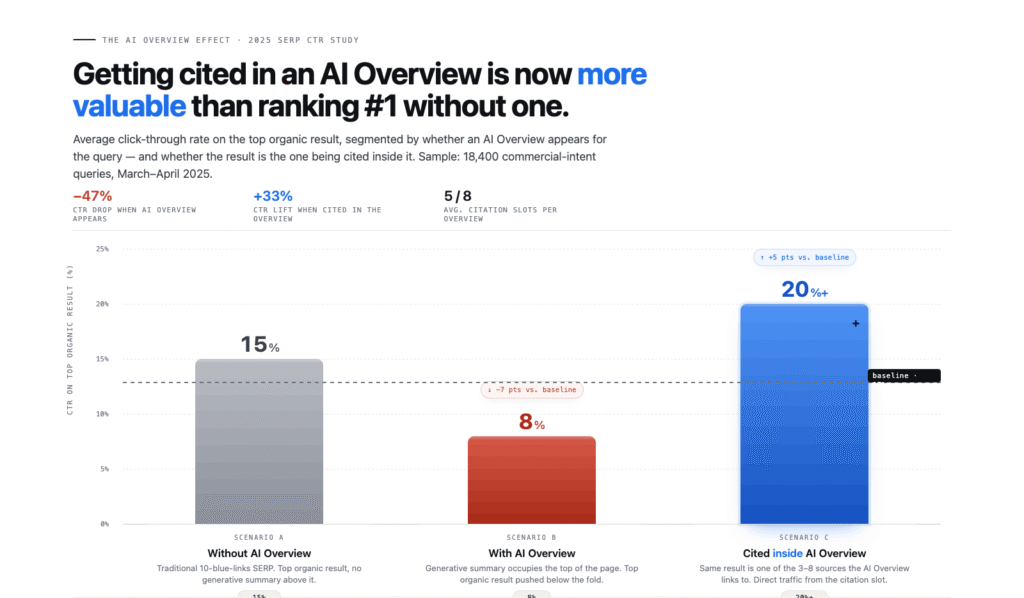
Getting cited in Google AI Overviews is now more valuable than ranking #1 in traditional organic results. Sites cited inside AI Overviews receive 35% more organic clicks than uncited sites, while pages that rank #1 but aren’t cited lose up to 61% of their traffic when an AI Overview appears above them. AI Overviews now show up on roughly half of all Google searches, and that number is climbing every month.
The old SEO playbook, write content, build links, rank #1, get traffic, still matters, but it’s no longer enough on its own. In 2026, the game has split into two tracks: traditional rankings AND AI Overview citations. You need both. This guide covers the 9 specific steps that get your pages cited inside Google AI Overviews, backed by data from Ahrefs, Seer Interactive, and multiple large-scale CTR studies published in the first half of 2026.
What Google AI Overviews Actually Are (And Why They Changed Everything)
Google AI Overviews are AI-generated answer summaries that appear at the top of search results for qualifying queries. When triggered, they pull information from multiple web sources, synthesize it into a paragraph or structured answer, and display it above every organic result on the page. Each AI Overview includes inline citations, clickable links to the source pages it referenced.
The critical detail: when an AI Overview fully answers a user’s question, many users never scroll down to the traditional blue links. Your page might still rank #1, but fewer people click on it because the AI Overview already gave them what they needed.
Here’s how fast this has changed. AI Overviews appeared on fewer than 5% of searches during Google’s 2024 rollout. By January 2026, that number had reached roughly 26% of US searches. By mid-2026, multiple studies put the figure between 48% and 58% depending on the query sample. Informational queries, the kind most businesses target for top-of-funnel content, trigger AI Overviews more than 70% of the time.
The impact on traffic is measurable. A Pew Research Center study across 68,000 queries found click rates dropped from 15% to 8% when an AI Overview appeared, a 46.7% relative decline. Ahrefs found that when an AI Overview appears, the top-ranking page’s average click-through rate falls sharply, a decline that now reaches well over 30% for position-one results across large keyword samples. Seer Interactive’s study of 53 brands and 5.47 million queries confirmed the pattern: impressions stay flat while clicks decline sharply.
But here’s the part most people miss: sites that get cited inside AI Overviews don’t lose traffi, they gain it. Being referenced as a source within an AI Overview delivers 35% more clicks than traditional organic results. The traffic loss hits the sites that rank well but aren’t cited. The sites that are cited actually benefit from AI Overviews.
That’s why getting cited is now the highest-priority SEO objective for any business that depends on organic search.
Step 1: Lead Every Section with a Direct, Extractable Answer
Google AI Overviews extract specific claims and statements from your content. Pages that bury the answer inside long introductory paragraphs get passed over in favor of pages that lead with a clear, concise answer in the first 1-2 sentences of each section.
Look at how AI Overviews work: they scan your page, find the section most relevant to the query, and pull a specific sentence or short passage to include in the generated summary. If your most relevant statement is buried in paragraph four of a 500-word section, the AI is less likely to find it, or it’ll find a competitor’s version first.
How to fix this: For every H2 section on your page, write the first sentence as if someone asked the question directly. The answer should be factual, specific, and self-contained. Then expand with supporting detail, context, and nuance below it.
Instead of: “When businesses consider their marketing budgets, there are many factors that influence how much they allocate to different channels…”
Write: “Content writing for SEO costs between $0.08 and $0.25 per word in 2026, depending on the writer’s experience, research depth, and whether the content includes keyword optimization and entity structuring.”
The second version is what gets extracted and cited. The first version gets ignored.
Step 2: Build Deep Topical Authority, Not Isolated Pages
Google AI Overviews don’t just evaluate individual pages. They evaluate whether your entire site demonstrates depth and expertise on a topic. A single blog post about link building won’t get cited nearly as often as a site that has a link building service page, a link building pricing guide, a link building FAQ, and multiple supporting articles, all interlinked.
This is called topical authority, and multiple studies confirm it’s one of the strongest signals for AI Overview citation. Pages above 20,000 characters average approximately 10 AI Overview citations each, while pages under 500 characters average just 2.4.
How to build it: Pick your core topics (for most businesses, these align with your services) and create content clusters around each one. Every cluster needs a main service page, a comprehensive guide, supporting blog posts, and FAQ content, all linked to each other with relevant anchor text.
For example, AutiMark’s link building cluster includes a link building service page, a detailed link building pricing guide, and supporting content on link building methods, risks, and best practices. Each page links to the others, creating a web of topical depth that AI Overviews recognize and cite.
Step 3: Implement Schema Markup That AI Overviews Can Parse
Schema markup makes your content machine-readable. Google AI Overviews use structured data to understand what your page is about, verify factual claims, and determine whether your content is trustworthy enough to cite.
The schema types that matter most for AI Overview citation:
FAQPage schema — the single highest-impact schema type. FAQ content structured with proper schema gets extracted by AI Overviews at significantly higher rates than unstructured FAQ content. Add this to every page with Q&A content.
Article schema — with proper author (Person schema), datePublished, dateModified, and publisher attribution. AI Overviews favor content with verifiable authorship.
Service schema with pricing — using hasOfferCatalog and UnitPriceSpecification. When someone searches for pricing information, AI Overviews pull from pages with structured pricing data.
AggregateRating and Review schemas — for pages with testimonials or reviews. AI Overviews cite review data when answering “best of” and comparison queries.
Organization schema — with sameAs links pointing to your directory profiles. This reinforces your entity identity across the web.
If your site doesn’t have comprehensive schema markup, that’s one of the fastest wins available. On-page SEO packages that include full schema implementation can close this gap in days, not months.
Step 4: Target Queries Where AI Overviews Actually Appear

Not every Google search triggers an AI Overview. Optimizing for queries that never generate AI Overviews is wasted effort if your goal is citation.
The data breaks down clearly by intent type:
Highest AI Overview rates (optimize for these): Informational queries — “what is”, “how to”, “why does”, “best practices for” — trigger AI Overviews 40-70% of the time. Definition queries, explanation queries, and comparison queries are the most likely to generate citations.
Moderate AI Overview rates: Commercial research queries — “best for [use case]”, “[brand] vs [brand]”, “top [services] in [location]” — trigger AI Overviews roughly 20-30% of the time and are growing.
Lowest AI Overview rates (still valuable for clicks): Transactional queries — “buy”, “order”, “pricing”, “sign up” — trigger AI Overviews only about 4% of the time. These queries still drive traditional clicks and conversions.
Local queries — “near me”, “[service] in [city]” — trigger AI Overviews about 7% of the time. The local pack still dominates for these.
How to use this: Audit your target keyword list and identify which queries trigger AI Overviews today. Test your top 30-50 keywords manually in Google — search each one and note whether an AI Overview appears. Focus your citation optimization efforts on the queries where AI Overviews are active.
Step 5: Create Original Data and Unique Perspectives
AI Overviews strongly favor content that contains original data, proprietary research, unique statistics, or first-person expertise that can’t be found elsewhere. Content that simply rephrases information available on 20 other websites is less likely to be cited because the AI has no reason to choose your version over any other.
What counts as original: Survey results from your own customers or audience. Case study data with specific metrics (“+187% organic traffic in 6 months”). Pricing research compiled from multiple sources into a new analysis. Industry benchmarks calculated from your own client work. Expert opinions based on direct experience, not generic advice.
This is why our link building pricing guide gets cited, it contains specific, researched pricing data from 15+ providers compiled into one comparison. That original analysis gives AI Overviews a reason to cite our page over a competitor’s generic “link building is important” article.
How to apply this: Every blog post you publish should contain at least one original data point, one specific number from your own experience, or one perspective that readers can’t find anywhere else. This is the single biggest differentiator between content that gets cited and content that doesn’t.
Step 6: Structure Content for AI Extraction
AI Overviews don’t read your page the way a human does, start to finish, appreciating your narrative flow. They scan for extractable passages: self-contained statements that answer a specific question and can be pulled into a summary without losing meaning.
Formatting rules that increase extraction probability:
Use clear H2 headers that match user queries. If someone searches “how much does SEO cost in Canada”, your H2 should be “How Much Does SEO Cost in Canada?”, not “Understanding the Canadian SEO Investment Landscape.”
Keep paragraphs short. 2-4 sentences maximum. Long paragraphs make it harder for AI to isolate a specific extractable claim.
Use specific numbers instead of vague qualifiers. “SEO retainers cost $1,999-$7,999 per month” gets cited. “SEO retainers vary in cost depending on multiple factors” does not.
Include bulleted or numbered lists for multi-part answers. AI Overviews frequently extract list content because it’s already structured as discrete, parseable items.
Front-load each section. The first sentence of every H2 section should be the answer. Everything after it is supporting detail.
Step 7: Earn Backlinks That Build Citation Authority
Domain authority matters for AI Overview citation, but the relationship is more nuanced than simple “more links = more citations.” Google AI Overviews appear on 48% of all searches, but only 38% of the pages they cite rank in the organic top 10, according to an Ahrefs study of 863,000 keywords.
What matters is the combination of ranking authority AND content quality. Backlinks get you into the top 10. Content structure, depth, and originality determine whether the AI Overview pulls from your page or a competitor’s.
The practical approach: Build editorial backlinks to your most important content pages — your service pages, your comprehensive guides, and your data-rich blog posts. Quality over quantity. A single DR 50+ link from a relevant industry publication does more for citation authority than 20 DR 15 links from generic sites. For a detailed breakdown of what this costs, see our guide on how much link building costs in 2026.
Also build backlinks to your homepage and key category pages to raise overall domain authority, which lifts all pages across your site.
Step 8: Keep Content Fresh and Updated
AI Overviews show a measurable preference for recently updated content. Pages with a recent dateModified in their Article schema get cited more frequently than identical content with a stale date. Google has explicitly stated that freshness is a factor in AI Overview source selection.
What “fresh” means practically:
Update your key blog posts every 90 days. Add new data points, refresh statistics, update examples, and modify the dateModified in your schema. A 2024 article updated with 2026 data outperforms a 2026 article that was never touched after publishing.
Publish new content consistently. Sites that publish regularly signal to Google that they’re actively maintained and current. Two quality posts per week is the benchmark that balances volume with depth.
Remove or consolidate outdated content. Old pages with stale information that you’re not planning to update should be either refreshed, redirected to a newer page, or noindexed. Outdated content on your domain can reduce overall site quality signals.
Our managed SEO plans include ongoing content refreshes as a standard deliverable because consistent freshness directly impacts both rankings and AI Overview citation rates.
Step 9: Monitor Citations and Close Competitive Gaps
You can’t improve what you don’t measure. Weekly monitoring of your AI Overview presence tells you which pages are getting cited, which queries you’re missing, and where competitors are winning citations you should be earning.
Weekly monitoring process:
Search your top 30-50 target keywords in Google. Note which queries trigger AI Overviews, whether your content is cited, and which competitor pages appear instead. Track this in a spreadsheet, over 8-12 weeks, patterns emerge that tell you exactly where to focus.
Check Google Search Console for the gap between impressions and clicks. Queries where impressions are high but CTR is unusually low (below 2%) likely have an AI Overview sitting above your organic result. These are your highest-priority optimization targets.
Test the same queries in ChatGPT, Perplexity, and Microsoft Copilot. AI Overview optimization overlaps significantly with broader AI search optimization. The same content improvements that get you cited in AI Overviews also improve your visibility across ChatGPT and Perplexity. For a complete guide on that broader strategy, see our article on how to get your brand cited by ChatGPT.
When you find queries where a competitor is cited and you’re not, analyze what their cited page has that yours doesn’t. More specific data? Better structure? Fresher date? Stronger schema? Then close that gap with targeted improvements to your own content.
What Happens If You Don’t Adapt
The numbers are blunt. Gartner projected a 25% decline in organic search traffic to commercial websites by 2026 as users shift toward AI-powered discovery. That projection appears to be on track.
But the decline isn’t spread evenly. Sites that adapt, implementing schema, restructuring content for extraction, building topical authority, and earning citations, are holding or growing their organic traffic. Sites that run the same 2022 playbook are watching traffic erode month over month with no recovery in sight.
The gap between adapted and unadapted sites will widen through 2026 and 2027 as AI Overviews expand to more query types and more countries. The cost of waiting is compounding traffic loss that becomes harder to recover the longer you delay.
The good news: every step in this guide is actionable today. You don’t need a six-figure budget or an enterprise team. You need structured content, proper schema, consistent publishing, and a monitoring system that tells you what’s working. Start with the pages that drive the most revenue and expand from there.
FAQ — Google AI Overviews and SEO
How do I know if my content is being cited in Google AI Overviews? Search your target keywords manually in Google and look for the AI Overview box at the top of results. If your page is cited, you’ll see your domain listed as a source with a clickable link. Google Search Console also shows impressions and clicks for queries where AI Overviews appear, though it doesn’t separate AI Overview traffic from traditional organic traffic yet.
Do Google AI Overviews appear on every search? No. AI Overviews appear on roughly 50-58% of US searches as of mid-2026, with the highest rates on informational queries (40-70%) and the lowest on transactional queries (about 4%) and local queries (about 7%). The coverage rate is expanding monthly.
Can I rank #1 and still lose traffic to AI Overviews? Yes. Multiple studies confirm that ranking #1 loses 18-61% of its clicks when an AI Overview appears above it. The traffic goes to users who got their answer from the AI Overview without clicking, or to the sites cited within the AI Overview itself.
Is it better to be cited in an AI Overview or rank #1 organically? Both. But if forced to choose, citation may deliver more value. Sites cited in AI Overviews get 35% more clicks than uncited sites. Additionally, only 38% of pages cited in AI Overviews also rank in the top 10, meaning citation and ranking are increasingly independent. Winning both is the strongest position.
Does schema markup help with AI Overview citations? Yes. FAQPage schema, Article schema with proper authorship, and Service schema with structured pricing all increase the probability of AI Overview citation. Schema makes your content machine-readable, which directly helps Google’s AI extract and reference your information.
How long does it take to start getting cited in AI Overviews? If your page already ranks in the top 10 for a target query, content restructuring and schema improvements can lead to citation within weeks. For pages not yet ranking, the timeline is similar to traditional SEO: 3-6 months of consistent content, link building, and technical optimization. See SEO pricing for plans that cover both traditional rankings and AI citation optimization.
Google AI Overviews are reshaping how search works. AutiMark’s AI SEO service optimizes your content for both traditional Google rankings and AI Overview citations, so you show up in the answer, not below it. View AI SEO packages →